Our team provides professional soot cleanup, and odor removal for residential, commercial, and industrial properties across Los Angeles County, Ventura County, and Orange County.
Smoke damage is most commonly caused by a fire event, which is why professional Fire Damage Restoration is often required before the smoke cleanup process can begin. Meanwhile smoke residue spreads quickly, contaminates surfaces, affects air quality, and can cause long-term damage if not treated properly.
However our certified team restores indoor environments by removing soot, eliminating odors, cleaning surfaces, and improving air quality using IICRC-compliant smoke restoration practices.
Smoke travels through air ducts, attics, walls, and hidden cavities, leaving behind toxic residue and odors.
Our structured restoration process includes soot removal, deep cleaning, environmental stabilization, odor elimination, and complete purification of the affected space. When structural components are damaged, our Reconstruction & Build-Back team restores walls, ceilings, flooring, and framing to return the property to its pre-loss condition.
We address all types of smoke damage, including protein residue, dry soot, wet soot, and wildfire smoke intrusion.
The CDC warns that smoke residue and fine particulates may remain embedded in surfaces long after a fire, requiring professional removal and filtration.
Smoke affects building materials differently depending on the type of fire and residue produced.
Our certified restoration team uses specialized tools and advanced deodorization systems to remove soot from surfaces, clean HVAC systems, neutralize smoke odors, and restore indoor air to safe, breathable conditions. When smoke damage is caused by a house fire, our Residential Fire Damage Restoration specialists stabilize the structure, remove hazardous debris, and begin the full smoke cleanup process to restore the home safely.
Protein & grease smoke residue from kitchen fires
Wet smoke damage caused by slow, smoldering materials
Dry smoke residue from fast-burning, high-heat fires
Puffback smoke from malfunctioning furnaces or boilers
Nicotine & cigarette smoke odor contamination
Soot buildup on walls, ceilings, & interior surfaces
HVAC & duct smoke contamination, including wildfire smoke intrusion
Every property type requires a tailored approach to smoke damage.
We create customized restoration plans based on the level of smoke penetration, building materials, and structural layout. Large buildings and business facilities require specialized equipment and coordinated cleanup efforts. Our Commercial Fire Damage Restoration team restores offices, retail properties, and commercial structures affected by fire and smoke contamination.
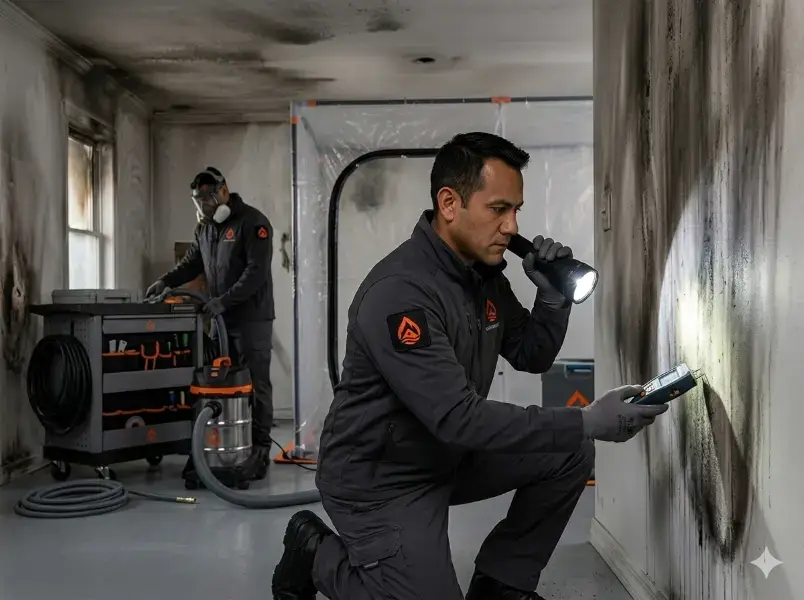
We assess smoke penetration, identify soot types, check air quality, and locate hidden contamination inside walls, ductwork, and structural cavities.
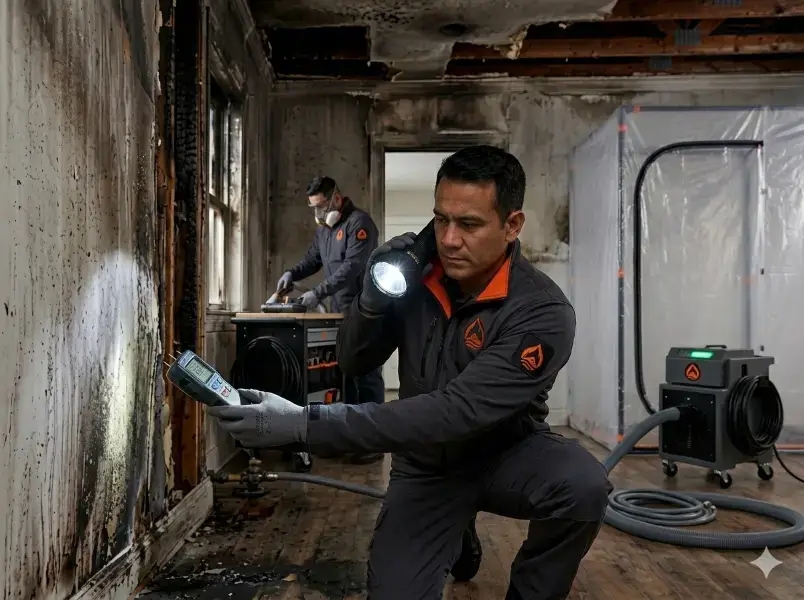
Our specialists remove soot from walls, ceilings, flooring, cabinets, and furnishings using industry-approved smoke cleaning techniques.

We deploy HEPA air scrubbers, ozone generators, hydroxyl units, and thermal fogging treatments to eliminate airborne particles and completely neutralize smoke odors.
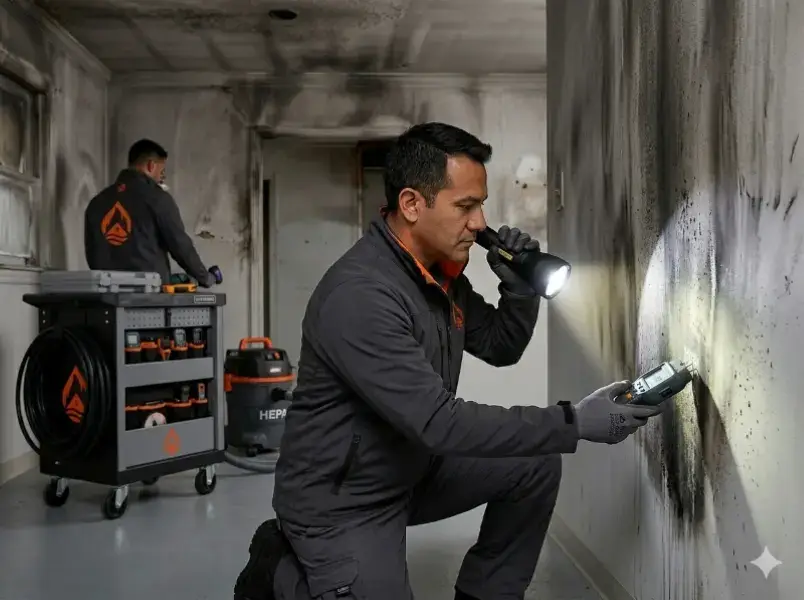
We sanitize affected surfaces, clean HVAC systems, treat odors at the molecular level, and restore the property to safe living conditions.
Smoke and soot damage can affect every surface in a property after a fire. In offices, retail properties, and large commercial facilities, smoke contamination can spread rapidly through ventilation systems and shared spaces, which is why our Commercial Smoke Damage Restoration specialists use advanced cleaning and filtration methods to fully restore indoor environments.During the smoke damage restoration process, restoration professionals evaluate the full extent of smoke and soot damage to determine which materials can be restored and which materials require removal. Smoke particles travel quickly through a building and often reach affected areas far beyond the room where the fire started.
The first step in smoke and soot removal is identifying all affected surfaces and materials that were exposed to smoke. Porous materials such as drywall, insulation, carpets, and fabrics often absorb soot particles and smoke odor. Non-porous surfaces like metal, glass, and tile may still collect heavy soot residue and require specialized cleaning techniques.
Professional technicians use advanced equipment and industry-approved professional cleaning solutions to safely remove soot residue from walls, ceilings, flooring, and ceiling fixtures. Improper cleaning can spread soot across other surfaces and cause additional staining or further damage, which is why professional restoration services are strongly recommended.
The next step involves structural cleaning of building materials. This includes deep cleaning of framing, subfloors, and structural components that were directly affected by smoke. During this phase, technicians carefully remove soot buildup and contaminants to restore the property to its pre loss condition.
If heavy smoke damage is present, additional restoration procedures may be required. Some affected materials may need to be removed to prevent smoke odor from returning later. Restoration teams carefully evaluate each material and determine the best method for removal, cleaning, or restoration.
Throughout the restoration process, technicians work to protect areas that were not directly affected by smoke to prevent cross-contamination. Proper containment and specialized filtration equipment help capture airborne soot particles and maintain a controlled environment during cleaning.
Once soot removal and deep cleaning are complete, restoration specialists evaluate the property for any additional restoration needs, including structural repairs or reconstruction work. The goal of the restoration process is to safely return the property to its original condition while eliminating all smoke contamination. In large facilities and warehouses where smoke contamination can spread through machinery areas and structural systems, our Industrial Fire Damage Restoration specialists handle complex fire recovery, soot removal, and structural stabilization.
Instant restoration delivers a structured and reliable approach to smoke damage restoration. Additionally our team understands how smoke spread through a property, affecting surfaces, HVAC systems, and air quality. We use proven smoke cleanup methods, HEPA air filtration, and advanced deodorization systems to remove contamination safely and efficiently.
From inspection to odor removal and full restoration, we provide clear communication, fast response times, and consistent results. Whether the smoke came from a fire, kitchen incident, or wildfire intrusion, our specialists restore it.
Also Instant Restoration provides a structured smoke damage restoration process. Our team uses professional smoke cleanup methods, HEPA air filtration, and targeted deodorization to restore safe, clean, and comfortable indoor environments. For homes affected by smoke contamination after a fire, our Residential Smoke Damage Restoration specialists remove soot residue, eliminate smoke odors, and restore healthy indoor air quality.
We evaluate the type of soot, measure smoke penetration, and assess air quality to determine the correct cleaning and deodorization approach.
We install containment barriers to isolate affected areas, prevent cross-contamination, and protect clean spaces during the smoke cleanup process.
Our HEPA air scrubbers run continuously to capture airborne smoke particles, reduce odors, and improve indoor air quality while work is performed.
We remove soot from walls, ceilings, doors, trim, cabinetry, appliances, and other interior surfaces using specialized smoke restoration tools and cleaning agents.
We apply professional odor treatments, including thermal fogging, ozone, or hydroxyl systems, to neutralize smoke odors at the source rather than just masking them.
We clean air ducts, vents, and filters so smoke residue does not continue to circulate through the property after the restoration is complete.
When a house fire occurs, smoke travels rapidly throughout the structure and can cause extensive damage in a short period of time. Even areas far from the original fire source may experience fire smoke damage due to the movement of smoke through hallways, ventilation systems, and open spaces. In large manufacturing plants, warehouses, and industrial facilities, smoke contamination can spread across complex structures and equipment, which is why our Industrial Smoke Damage Restoration specialists handle large-scale soot removal and air purification.
Smoke is made up of microscopic particles that settle onto surfaces and form soot residue. These particles attach to walls, furniture, appliances, and flooring, leaving behind dark stains and persistent odors. Over time, soot residue can discolor walls and permanently damage materials if it is not properly removed.
Certain building materials are especially vulnerable to smoke contamination. Porous materials such as drywall, insulation, upholstery, and carpeting absorb smoke particles deep into their structure. These materials often require specialized smoke damage cleanup procedures to fully remove smoke odor and soot buildup.
Another factor that contributes to property damage is the response from the fire department. During firefighting efforts, large volumes of water are used to extinguish flames and control the spread of fire. This can introduce additional moisture into the property, which may require water removal and water extraction as part of the overall restoration effort.
Smoke damage may also affect lighting systems and ceiling fixtures, leaving behind soot buildup that must be carefully cleaned. If soot particles remain on surfaces for an extended period of time, they can cause corrosion, staining, and long-term damage to materials.
Because smoke particles are extremely small, they often spread throughout the property and contaminate many affected areas. Professional restoration teams evaluate the entire structure to identify all locations where smoke traveled. This helps prevent hidden contamination from causing odor problems in the future. As part of our complete restoration approach, property owners can explore all of Our Services, including fire damage restoration, smoke damage restoration, water damage restoration, mold remediation, and full reconstruction solutions.
The timeline for restoring a property after smoke damage varies depending on the severity of the fire and the level of contamination. In some cases, smoke damage restoration can be completed within a few days, while larger restoration projects may take several weeks to fully complete. Restoration specialists provide property owners with an estimated timeline based on the size of the property and the amount of damage present.
Professional restoration services focus on removing soot, restoring damaged materials, and ensuring the property is safe for occupants to re enter once cleaning and repairs are complete. With the correct equipment and proper cleaning techniques, restoration professionals can successfully restore properties affected by fire smoke and soot damage.
Fires are almost always followed by secondary damage from firefighting water. This creates conditions for water damage, structural saturation, and rapid mold growth within 24–48 hours if not extracted and dried immediately. When firefighting activities also impact drainage or sewage systems, flood damage and sewage cleanup may be required as part of the full restoration scope. Our team coordinates all damage categories in a single structured process.
We Serve Homes, Commercial Facilities & Industrial Structures Across Southern California.
Woodland Hills – 91364, 91365, 91367
Calabasas – 91302
Hidden Hills – 91302
West Hills – 91307
Canoga Park – 91303, 91304
Winnetka – 91306
Reseda – 91335
Tarzana – 91356
Encino – 91316
Sherman Oaks – 91403, 91423
Van Nuys – 91401, 91405, 91406, 91411
North Hills – 91343
Northridge – 91324, 91325
Granada Hills – 91344
Mission Hills – 91345
Porter Ranch – 91326
Chatsworth – 91311
Sylmar – 91342
Pacoima – 91331
Arleta – 91331
Panorama City – 91402
Sun Valley – 91352
Santa Monica – 90401, 90402, 90403, 90404, 90405
Pacific Palisades – 90272
Brentwood – 90049
Westwood – 90024
Bel Air – 90077
Beverly Hills – 90210, 90211, 90212
Century City – 90067
West Los Angeles – 90025
Venice – 90291
Mar Vista – 90066
Culver City – 90230, 90232
Playa Vista – 90094
Playa Del Rey – 90293
Marina Del Rey – 90292
Malibu – 90265
Topanga – 90290
Hollywood – 90028, 90038
West Hollywood – 90046, 90048, 90069
Los Angeles (all districts):
90001, 90002, 90003, 90004, 90005, 90006,
90007, 90008, 90010, 90011, 90012, 90013,
90014, 90015, 90016, 90017, 90018, 90019,
90020, 90021, 90022, 90023, 90024, 90025,
90026, 90027, 90028, 90029, 90031, 90032,
90033, 90034, 90035, 90036, 90037, 90038,
90039, 90041, 90042, 90043, 90044, 90045,
90046, 90047, 90048, 90049, 90056, 90057,
90058, 90059, 90061, 90062, 90063, 90064,
90065, 90066, 90067, 90068, 90069, 90071,
90077, 90094, 90095
Manhattan Beach – 90266
Hermosa Beach – 90254
Redondo Beach – 90277, 90278
El Segundo – 90245
Hawthorne – 90250
Inglewood – 90301, 90302, 90303, 90304, 90305
Torrance – 90501, 90502, 90503, 90504, 90505
San Pedro – 90731, 90732
Wilmington – 90744
Pasadena – 91101, 91103, 91104, 91105, 91106, 91107
Altadena – 91001
Arcadia – 91006, 91007
Sierra Madre – 91024
Temple City – 91780
San Gabriel – 91775, 91776
Alhambra – 91801, 91803
Monterey Park – 91754, 91755
Rosemead – 91770
El Monte – 91731, 91732, 91733
Duarte – 91010
Santa Clarita – 91350, 91351
Valencia – 91354, 91355
Newhall – 91321
Canyon Country – 91387
Stevenson Ranch – 91381
Castaic – 91384
Ventura – 93001, 93003, 93004
Oxnard – 93030, 93033, 93035, 93036
Port Hueneme – 93041, 93044
Channel Islands Beach – 93035
Silver Strand – 93035
Hollywood Beach – 93035
La Conchita – 93001
Thousand Oaks – 91360, 91362
Newbury Park – 91320
Westlake Village (VC side) – 91361
Oak Park – 91377
Agoura Hills (VC portion) – 91301
Simi Valley – 93063, 93065
Moorpark – 93021
Somis – 93066
Santa Rosa Valley – 93012
Ojai – 93023
Mira Monte – 93023
Meiners Oaks – 93023
Oak View – 93022
Santa Paula – 93060
Fillmore – 93015, 93016
Piru – 93040
Anaheim – 92801, 92802, 92804, 92805, 92806, 92807, 92808
Fullerton – 92831, 92832, 92833, 92835
Buena Park – 90620, 90621, 90622
La Habra – 90631, 90632, 90633
Brea – 92821, 92823
Placentia – 92870
Yorba Linda – 92886, 92887
La Palma – 90623
Santa Ana – 92701, 92703, 92704, 92705, 92706, 92707
Orange – 92865, 92866, 92867, 92868, 92869
Garden Grove – 92840, 92841, 92842, 92843, 92844, 92845
Tustin – 92780, 92782
Villa Park – 92861
Costa Mesa – 92626, 92627, 92628
Huntington Beach – 92646, 92647, 92648, 92649
Newport Beach – 92657, 92658, 92659, 92660, 92661, 92662, 92663
Seal Beach – 90740
Sunset Beach – 90742
Irvine – 92602, 92603, 92604, 92606, 92612, 92614, 92617, 92618, 92620
Lake Forest – 92630
Foothill Ranch – 92610
Mission Viejo – 92691, 92692, 92694
Rancho Santa Margarita – 92688
Coto de Caza – 92679
Aliso Viejo – 92656
Laguna Hills – 92653, 92654
Laguna Woods – 92637
Laguna Beach – 92651, 92652
Laguna Niguel – 92677
Dana Point – 92624, 92629
Capistrano Beach – 92624
San Clemente – 92672, 92673, 92674
San Juan Capistrano – 92675
Frequently Asked Questions by our clients.
Yes. When soot cleaning, air purification, and odor treatment are performed properly, smoke damage can be completely eliminated.
Yes. Smoke contains acidic particles and toxins that can irritate lungs, damage materials, and affect long-term indoor air quality.
Most projects take a few days to a week depending on the level of smoke penetration and the size of the property.
Smoke damage refers to discoloration, odor penetration, and chemical residue left by smoke particles throughout the property. Soot is a black, oily byproduct of incomplete combustion that deposits on surfaces and inside HVAC systems. Both require professional treatment — soot can be acidic and causes permanent staining if not cleaned quickly, while smoke odor requires molecular-level deodorization to eliminate completely.
Yes, we remove soot using specialized cleaning agents and professional smoke restoration tools.
Immediately. Soot residue becomes more difficult to remove with each passing hour as it bonds chemically to surfaces. Smoke odor penetrates porous materials deeply within 24–48 hours. Acting fast limits the scope and cost of restoration. Our team responds within 45 minutes and begins containment, air filtration, and soot cleanup right away to prevent secondary damage from spreading.
Most policies include coverage for smoke events. We help with documentation, photos, and claim support.
Yes, we clean air ducts, filters, and mechanical systems to prevent odor recirculation.
If your property has experienced water, fire, smoke, mold, flood, or sewage damage, immediate action is critical. Contact Instant Restoration for fast, professional restoration services backed by experience, structure, and accountability.