Select the service that best matches your situation.
How would you like to connect?
Choose your preferred appointment type.
Pick a date & time
Available Monday–Saturday, 9 AM–5 PM.
Where can we reach you?
We’ll confirm your booking within the hour.
Emergency dispatch — we’ll call you within minutes of receiving this.
Thanks — we’ve got it.
We’ll call you within the hour at the number you provided. If this is an emergency, call us directly at (818) 486-6546.
Something went wrong.
We couldn’t send your request. Please call us at (818) 486-6546 — we’re standing by 24/7.
Santa Monica · Water Damage Restoration · IICRC S500
Water Damage Restoration in Santa Monica, CA
Water damage in Santa Monica runs four patterns: multi-unit cascades in the dense condo and apartment buildings along Wilshire, Santa Monica Boulevard, and downtown corridors; slab leaks in mid-century North of Montana estate residential where salt-air corrosion accelerates copper failure; coastal humidity infiltration on beachfront and ocean-facing properties; and storm surge and king tide intrusion during major storm events on beachfront residential. Coastal humidity means the drying window here is shorter than inland — unresolved water damage seeds mold within days. We dispatch from Woodland Hills HQ into Santa Monica via the 405/10 corridor. IICRC-certified technicians. CSLB #1078518 B-General Building. HAZWOPER-trained crews. Est. 2019.
★ 5.0 from 119+ reviews·CSLB #1078518 · B-General Building · HAZWOPER-trained crews·IICRC-certified technicians·Local Woodland Hills HQ
Section 01 · First 15 minutes
First 15 minutes — what to do before we arrive.
While our truck is en route, this is what protects your property and your insurance claim.
Shut off the main water valve.
Stops the source. Usually located near the front of the property, at the curb meter, or in a utility area.
Move soft goods off wet floors.
Rugs, drapes, electronics, furniture legs. Anything porous absorbs water fast.
Don’t run electrical near standing water.
Including extension cords, lamps, anything plugged in. Turn off the breaker to affected rooms if reachable safely.
Don’t try to dry it with home fans.
Standard fans push air across the surface but don’t pull moisture out of subfloor or wall cavity. Improper drying just spreads humidity — and coastal ambient humidity makes that worse.
Photograph everything before cleanup.
Insurance adjusters need timestamped damage documentation. The first photos you take matter most.
Section 02 · Local patterns
Water damage patterns in Santa Monica.
Most Santa Monica water damage falls into a handful of patterns — each needs a different approach, and coastal humidity turns a contained loss into a mold job faster than inland.
Multi-unit cascades in the dense condo and apartment corridors.
An upstairs unit floods and water drops through two to four units below, drywall ceilings absorbing and sagging — a common multi-family water-damage pattern in the dense condos and apartments along Wilshire, Santa Monica Boulevard, and the downtown corridors. We coordinate multi-tenant access through the property manager or HOA and document each unit separately for the insurance complexity (HOA policy vs unit owner vs landlord).
Slab leaks in North of Montana estate residential.
In mid-century North of Montana estate homes, salt-air corrosion accelerates copper failure, driving a high slab-leak rate — copper supply lines fail at fittings or pinhole through corrosion, often invisible until hardwood buckles or the water bill spikes. We locate with acoustic or thermal detection, make controlled slab access, repair, and dry to standard.
Coastal humidity and marine-layer infiltration.
On beachfront and ocean-facing properties, year-round marine-layer moisture enters through window seals, stucco, and exterior walls, holding chronic moisture in wall cavities and corroding plumbing and metal fixtures. An aggressive drying protocol is required.
Storm surge and king tide intrusion.
On beachfront residential, ocean water enters at ground level during major storm events — Category 3 (black) water carrying salt, sand, and contamination. It requires immediate drying plus antimicrobial and often flooring replacement, and coverage varies significantly (typically requiring separate flood insurance).
Supply-line ruptures.
Washing-machine hoses, dishwasher and refrigerator lines, and toilet supply lines across all property types — and in vacation and second homes, delayed discovery means a larger scope. Standard mitigation: shut-off, extraction, drying, containment.
Roof leaks during atmospheric-river events.
Older estate residential with tile roofs takes multi-day winter storm events that overwhelm older systems, driving attic saturation and ceiling damage.
Commercial water loss.
Restaurant kitchen and bathroom plumbing, retail supply lines and sprinkler activations, and hospitality and office overhead pipes along Wilshire, Main Street, and downtown — business interruption demands a fast response.
Section 03 · Our S500 process
Our IICRC S500 process, step by step.
IICRC S500 is the industry standard for water restoration — any Santa Monica water job follows it, run to a tighter coastal drying protocol.
S500 starts with categorizing the loss (1 clean / 2 gray / 3 black) and classifying its severity (Class 1–4), then documents the job throughout — initial moisture readings mapped to the floor plan, daily drying logs, photos, equipment placement records, and final dry verification. For multi-unit cascades, we document each unit separately so each carrier has what it needs. This documentation is what carriers require and what protects you in any dispute.
Santa Monica coastal humidity means water damage dried to inland standards can still seed mold within days. Our Santa Monica protocol runs tighter: extended drying times to hit lower moisture-content thresholds, larger dehumidification sizing for coastal ambient humidity, post-drying monitoring 24–48 hours to catch rebound moisture, and mold containment upgraded when coastal conditions warrant. The difference between a clean water restoration and a mold remediation job two weeks later is whether the drying was done to verified moisture readings — not guessed at, not assumed because the floor “feels dry.”
We follow IICRC S500 on every water damage job:
Emergency response — 24/7 dispatch from our Woodland Hills HQ via the 405/10 corridor
On-arrival assessment — source identification, water category (1 clean / 2 gray / 3 black), and damage class (1–4)
Source control — shut-off to stop the loss before extraction begins
Water extraction with truck-mount and portable units, including sub-floor extraction where needed
Structural drying with air movers and dehumidifiers, sized larger for coastal ambient humidity
Daily moisture monitoring — mapped to the floor plan and logged until materials reach the dry standard
Containment if mold risk — IICRC S520 protocols, upgraded when coastal conditions warrant
Reconstruction by the same team on our B-General license — drywall, flooring, paint, and cabinetry, with final dry verification documented for your carrier
Section 04 · Recent work
What a Santa Monica water job looks like.
Real photos from our own jobs — and what a water damage call in Santa Monica involves.
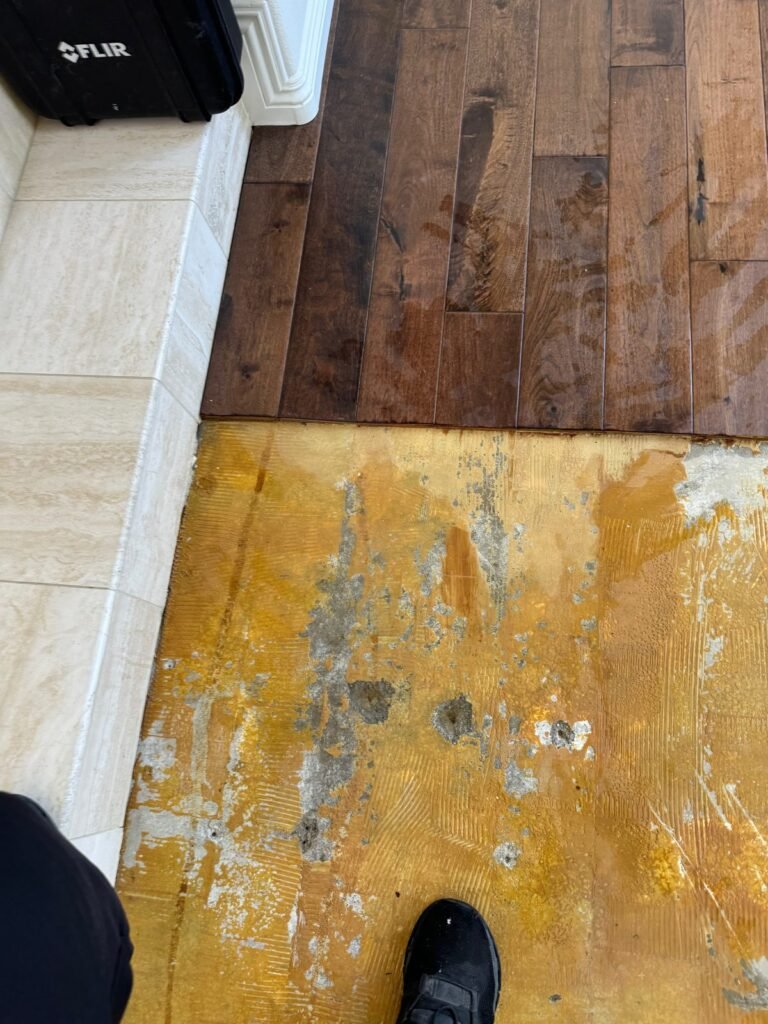
Santa Monica — water damage restoration: what the work looks like.
The photo is from an Instant Restoration water damage job in Calabasas, Los Angeles County: hardwood lifted showing stained mastic and moisture spotting on subfloor beneath. On a typical water damage call in Santa Monica the same licensed crew will stop the source, extract standing water, map moisture with meters and thermal imaging, set containment and commercial drying equipment, remove materials that cannot be dried, document every reading and photo for the insurance file, and rebuild with the same crew. We are a California-licensed general building contractor (CSLB #1078518), bonded and insured, and we answer 24/7.
The dry-out has to be verified, not assumed — and on the coast the mold window is shorter, so the job becomes a mold remediation call faster.
Section 05 · Why Santa Monica calls us
Why Santa Monica homeowners call us first.
One local, licensed team from the emergency call through the rebuild.
24/7 response from Woodland Hills HQ.
We dispatch from our Woodland Hills headquarters into Santa Monica via the 405/10 corridor. We answer 24/7 for water emergencies — after-hours and weekends included.
CSLB #1078518 — one license.
B-General Building Contractor. The crew that arrives on the emergency call owns the rebuild — mitigation through reconstruction, no subbing the rebuild to a third party. Our crews are HAZWOPER-trained.
IICRC-certified technicians.
Industry-standard water restoration documented on every job — moisture maps, daily drying logs, and final dry verification carriers recognize.
Multi-unit & slab-leak specialty.
Multi-unit cascades in the dense condos along Wilshire and Santa Monica Boulevard — a common damage pattern here — and salt-air-accelerated slab leaks in North of Montana estate residential: leak detection, controlled slab access, and parallel drying across affected units with per-unit documentation so each carrier has what it needs.
Insurance documentation built in.
Initial moisture readings, daily drying logs, equipment placement records, and final dry verification — what your carrier requires and what protects you in any dispute.
24/7 — we pick up the phone.
Nights, weekends, holidays. Water damage doesn’t keep business hours, and coastal humidity accelerates mold onset. We coordinate with property managers and landlords on multi-unit cascades.
Section 06 · Cost transparency
What water damage restoration costs in Santa Monica.
Water damage costs vary by scope. Typical ranges, not quotes — every job is scoped in writing after a free assessment.
Small water loss — $2,000–5,000 mitigation
Single room, minimal absorption.
Medium loss — $5,000–15,000 mitigation
Multi-room, slab leak, controlled access.
Multi-unit cascade — $10,000–35,000+ mitigation
Two to four condo units affected.
Class 4 specialty drying — $10,000–30,000+ mitigation
Hardwood, custom finishes.
Storm surge / king tide — $20,000–75,000+ mitigation
Category 3 beachfront water.
Commercial loss
Restaurant, retail, or office — scope-dependent, often $15,000–75,000+. Reconstruction adds 1.5–2x mitigation cost depending on materials and finish; Santa Monica market pricing runs higher than inland due to access, coastal materials, and estate finish specifications.
Section 07 · Common questions
Frequently asked questions.
The questions we hear most about water damage in Santa Monica.
How fast can you get to my Santa Monica property?
We dispatch from Woodland Hills HQ via the 405/10 corridor. We answer 24/7 for water emergencies. Coastal humidity means water damage cannot wait — we prioritize active water emergencies.
I am a property manager for a Santa Monica condo building. Can you coordinate multi-unit water damage?
Yes. Multi-family cascades are a common water-damage pattern in Santa Monica. We assess across all affected units, contain, coordinate extraction and drying, document per-unit so each carrier has what it needs, and coordinate reconstruction to minimize tenant displacement.
Do you do leak detection on slab leaks?
Yes — acoustic and thermal leak detection in-house. Salt-air corrosion accelerates copper slab leaks in Santa Monica’s North of Montana estate residential. We locate before opening the slab.
How long does drying take in Santa Monica?
Longer than inland. Coastal humidity means we run extended drying cycles and larger dehumidification. Standard jobs: 4–7 days. Slab leaks: 7–10 days. Storm surge Cat 3: 10–14+ days.
My beachfront property had storm surge water damage. Is that covered?
Storm surge coverage varies significantly by policy. Standard homeowner policies often exclude flood — separate flood insurance (NFIP or private) is typically required. We document thoroughly to support whatever coverage applies.
Can you coordinate with my HOA?
Yes. We coordinate with HOAs on multi-unit losses. Documentation built per-unit so HOA, unit owner, and tenant policies can all be addressed.
What if I waited and there is mold now?
We handle mold remediation in-house under IICRC S520. Santa Monica coastal mold is aggressive — assessment, containment, HEPA filtration, source removal, then clearance by an independent third-party hygienist you hire.
Do you handle commercial water damage on Wilshire, Main Street, or downtown?
Yes — restaurants, retail, hospitality, professional office. We coordinate with property managers and tenants to minimize business interruption.
Does my insurance cover this?
Coverage depends on your policy. Policies often treat sudden and accidental water damage differently from slow leaks and long-term seepage, and storm surge / flood generally requires separate coverage. We document the loss thoroughly for your carrier and adjuster — coverage is their decision, and payment is owed regardless of the insurance outcome.
Do you work nights and weekends?
24/7 dispatch. Coastal humidity accelerates mold onset — water damage in Santa Monica gets worse fast.
We run water damage restoration across the Westside and beyond under one license — mitigation through rebuild. Click into a nearby city for its fast local response.
Active water emergency in Santa Monica? Don’t wait.
Call Instant Restoration for a free on-site assessment and fast local response in Santa Monica. We answer 24/7 and dispatch from our Woodland Hills HQ into the Westside coast — after-hours and weekends included. We mitigate and rebuild — one team, one timeline. CSLB #1078518 · IICRC S500 · HAZWOPER-trained crews · Est. 2019.
We use cookies for analytics and, when our ad campaigns are active, advertising. California residents can opt out of the sale or sharing of personal information. Cookie Policy
Opt-out preferences
We use third-party cookies to analyze how the site is used and, when our ad campaigns are active, to measure and personalize advertising. Check the box below and save to opt out of the sale or sharing of your personal information for this browser. We also honor Global Privacy Control signals automatically. Strictly necessary cookies always remain active.