
To dry out a house, work in this order: make it safe, stop the water, get the standing water out, remove the materials that hold water, move air across everything wet, pull the moisture out of the air with dehumidifiers, and measure until the wet areas read the same as the dry ones. The deadline is short. The EPA’s guidance is to dry water-damaged areas and items within 24 to 48 hours to prevent mold growth. That’s how to dry out a house after water damage in one paragraph. The harder question is whether the fans and the dehumidifier you already own can do it. For a wet floor surface, often yes. For water inside walls, under flooring, or above a ceiling, usually not. This guide shows where that line is.
How do you dry out a house after water damage, step by step?
Drying is a sequence. Each step makes the next one work, and skipping one is how a house ends up dry on the surface and wet underneath.
- Make it safe. Power and contaminated water come first. More on that below.
- Stop the water. Shut off the fixture or the main.
- Extract. Pump, wet-vacuum, or mop out the standing water. Water that leaves in a hose never has to evaporate.
- Remove what holds water. Soaked rugs, carpet pad, and wet boxes go outside.
- Move air. Air moving across a wet surface carries moisture off it. Still air doesn’t.
- Dehumidify. That moisture goes into the air. Something has to take it out, or it goes right back into the house.
- Measure. Check the wet materials with a moisture meter every day until they match a dry part of the house.
If the water just arrived, start with our first 24 hours after water damage guide. This article is about the days after.
Is it safe to start drying right away?
Not always. Two things come first: electricity and the kind of water you’re dealing with.
Electricity. Ready.gov’s flood guidance says not to touch electrical equipment if it is wet or if you are standing in water, and to turn off the electricity if it is safe to do so. That applies to the fans you’re about to plug in, too. A generator stays outdoors and away from windows.
The water. Water from a supply line is clean when it arrives. Water from a sewage backup, or outside floodwater that ran across the ground before it came in, is not. Contaminated water changes the job: porous materials it touched, such as carpet, pad, and drywall, are removed, not dried, and the surfaces that stay are cleaned and sanitized before drying starts. That’s what our flood damage cleanup crew does, in protective gear.
Do fans and open windows actually dry a house?
They dry surfaces. A box fan pointed at a wet tile or concrete floor does real work, and so does a ceiling fan. What fans can’t do is reach water you can’t see: inside a wall cavity, in the insulation, under a floating floor, or beneath cabinets. Air has to touch a wet surface to dry it.
Open windows are a judgment call. On a dry, breezy day, outside air helps. On a damp or rainy day, you’re letting wet air in. Once a dehumidifier is running, close the windows. With them open, it’s trying to dry the neighborhood.
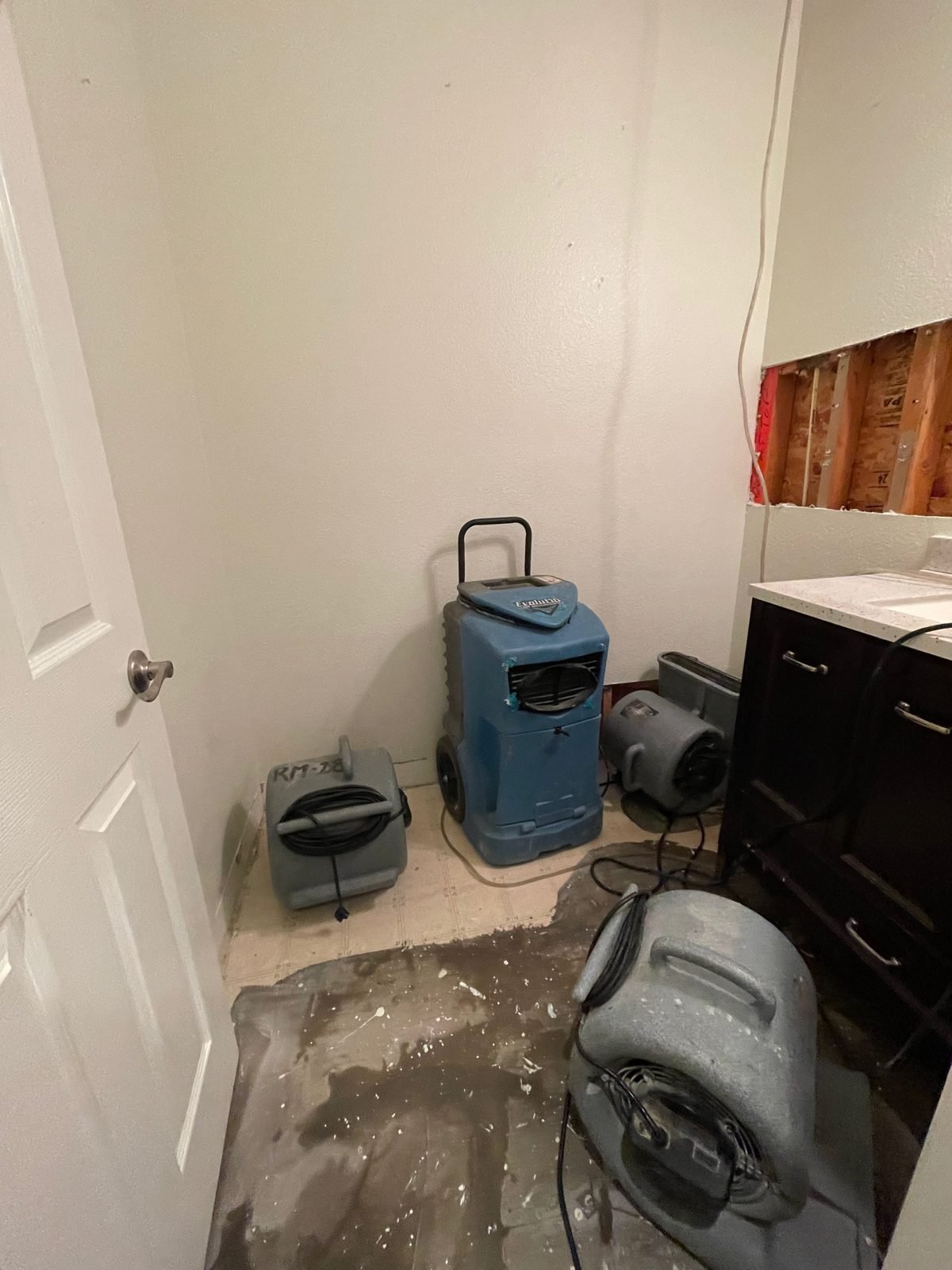
A drying setup on an Agoura Hills job: flooring pulled up, a section of wall cut open, air movers aimed at the wet areas, and a dehumidifier taking the moisture out of the air.
When is a dehumidifier not enough?
A household dehumidifier is built to keep a damp room comfortable. It was never meant to pull gallons of water out of soaked framing, subfloor, and drywall on a deadline. It’s the right tool when the water was shallow, clean, caught early, and stayed on a hard surface. It falls short in these situations:
- Water got inside the walls. If water sat against a wall, it wicked up the drywall and into the cavity behind it. A dehumidifier in the middle of the room does little for the inside of a closed wall.
- Water got under the flooring. Laminate, vinyl plank, and hardwood trap water against the subfloor. The top looks dry while the layer underneath stays wet.
- The water came from above. A leak from an upstairs bathroom or the roof means the ceiling cavity is involved, not just the room below.
- More than a day has passed. The closer you are to the end of the EPA’s 24 to 48 hour window, the less time a small machine has to catch up.
Professional structural drying is the same idea with more force and more access. Our water damage restoration crew uses truck or portable extraction, commercial air movers, and commercial dehumidifiers sized to the amount of wet material. When a cavity is holding water, we open it: baseboards come off, the bottom of the drywall is cut away in a straight line, and air is directed into the wall. Wet insulation comes out. Flooring that’s trapping water comes up.
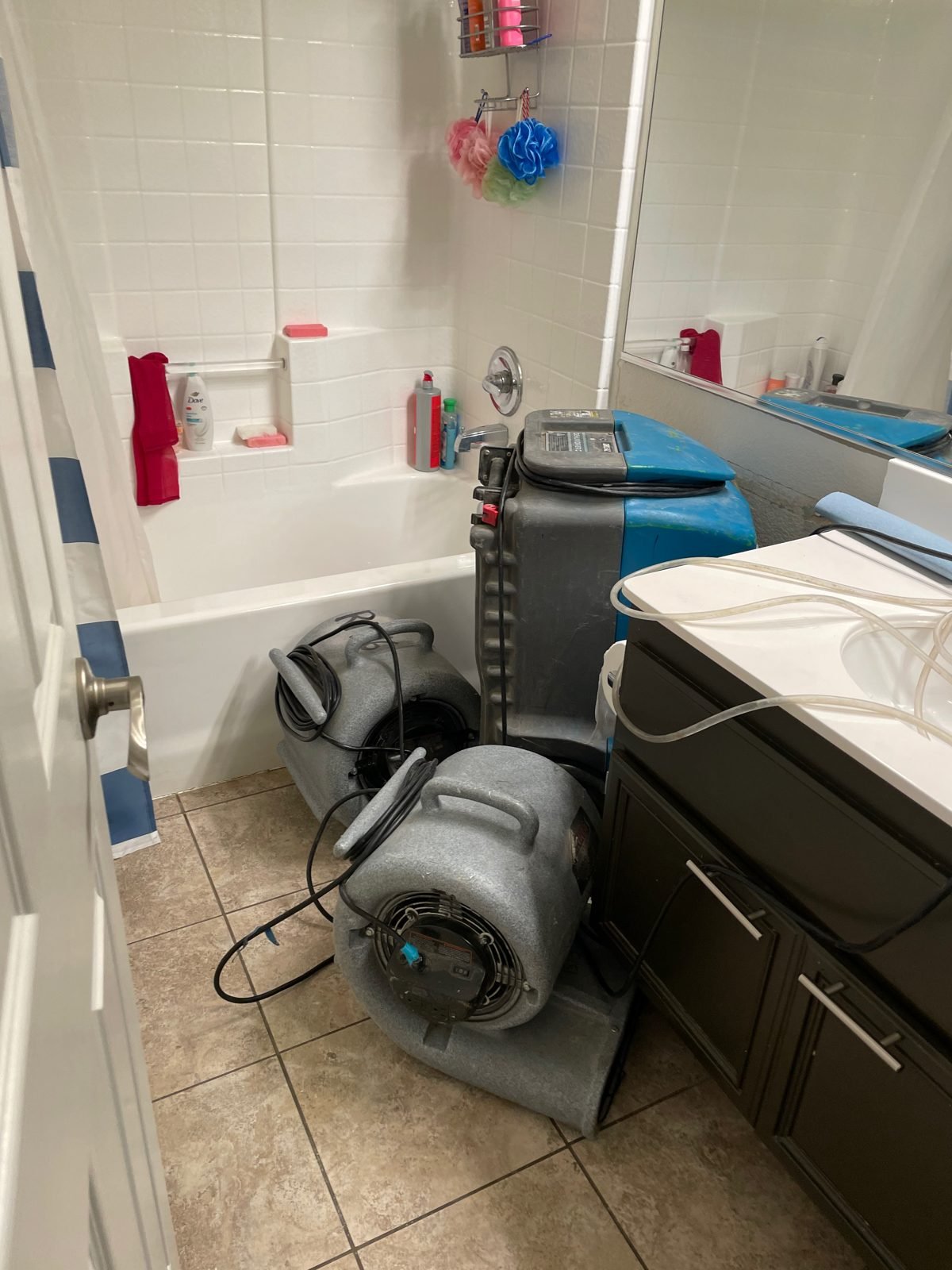
Agoura Hills again, in a bathroom: air movers push air across the wet surfaces, and the dehumidifier takes out the moisture they lift into the air.
How do you know when the house is actually dry?
You measure it. Dry to the touch isn’t dry. Paint and the face of drywall dry in hours. The framing behind them can hold water for days.
The method is simple. Take a moisture meter reading on the wet material, then take one on the same material in a part of the house the water never reached. That second number is your dry reference. When the wet area reads the same as the reference, it’s dry. Until then, equipment keeps running and walls stay open.
Watch the air as well. The EPA’s mold and moisture guide recommends keeping indoor humidity below 60 percent, ideally between 30 and 50 percent. An inexpensive humidity gauge from a hardware store will tell you whether your dehumidifier is keeping up. If the number won’t come down, the machine is too small for the amount of water in the house.
Don’t close anything up early. New drywall, paint, or flooring over damp framing traps the moisture with no way out. Our guide to reconstruction after water damage explains why the rebuild waits for the readings.
What has to be removed instead of dried?
Some materials dry well. Solid wood framing, concrete, and plywood subfloor usually can be dried in place if you get air to them. Others are faster and safer to replace:
- Carpet pad. It’s a sponge. It usually comes out even when the carpet above it can be saved.
- Wet insulation. It keeps the wall wet and loses its shape.
- Swollen particleboard, MDF, and laminate flooring. Once they swell, they don’t return to shape.
- Drywall that is soft, sagging, or crumbling. Drywall that stayed firm can often be dried. Drywall that lost its strength can’t.
- Anything porous that touched contaminated water.
If it has already been several days and you’re seeing or smelling mold, don’t run fans across it. Blowing air over mold growth spreads it. At that point the job is mold remediation under containment, with clearance by an independent third party. We do the remediation. Testing and clearance are done by someone else, on purpose. On health questions, we are restoration professionals, not medical professionals. If anyone in the house has symptoms or a condition you’re worried about, talk to a doctor.
Water in the house and not sure your fans are getting to all of it? Call (818) 486-6546. We answer 24/7, and you’ll get a written scope and price before work starts.
Oren Gedalia, Owner — IICRC-certified · CSLB #1078518