

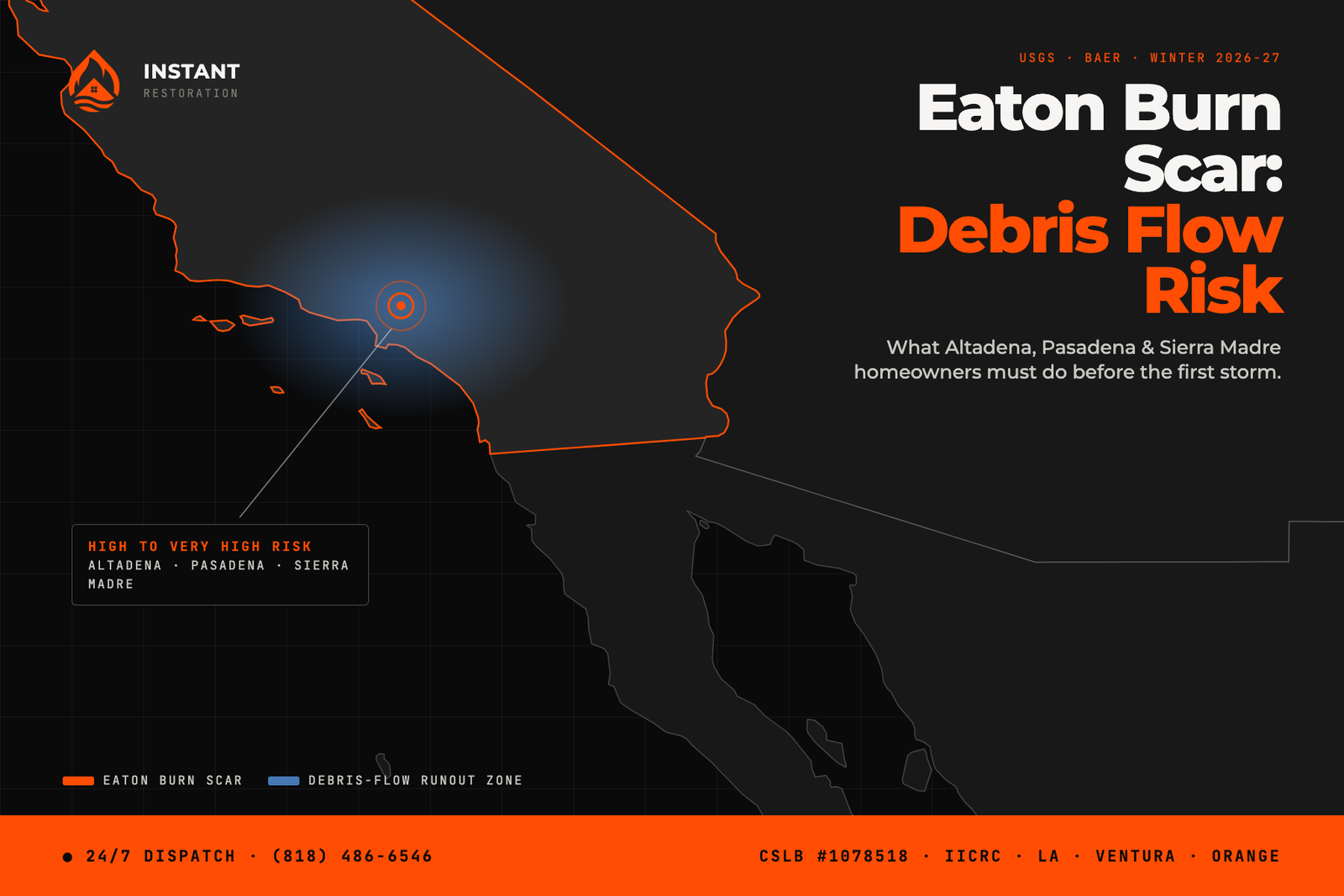
If your home sits below the San Gabriel foothills in Altadena, Pasadena, or Sierra Madre, this winter asks more of you than any in recent memory. The Eaton Fire stripped the slopes above roughly 170,000 residents, and burned ground doesn’t absorb rain — it sheds it, along with ash, soil, and rock. The result is the hazard officials keep repeating on every storm forecast: debris flow. Not a slow slide of mud, but a fast-moving slurry that carries boulders and takes out garden walls, cars, and first floors in seconds.
We restore flooded and mud-damaged homes across these neighborhoods, and the pattern from past California burn scars is consistent: the families who did an afternoon of preparation had wet driveways and a cleanup; the ones who didn’t had structural losses. Here’s what the science says about your specific hillside, and exactly what to do before the first real storm.
Why the Eaton Burn Scar Is a Special Case
Two numbers explain the risk. First, the federal post-fire assessment (BAER) rated the probability of debris flows in most channels of the Eaton burn area high to very high — that’s the assessment language, not a headline. Second, USGS modeling found that as little as 0.2 inches of rain in 15 minutes can trigger flows off the Eaton scar — one of the lowest thresholds measured in the region. That’s not a big storm. That’s one strong cell passing over the mountains while it drizzles at your house.
Burned slopes behave this way because intense heat leaves a water-repellent layer near the soil surface and burns off the vegetation that used to hold everything in place. Rain that a healthy hillside would drink runs off nearly instantly, picking up ash, soil, and rock as it accelerates downhill. Recovery takes years — and this is only the second winter since the fire, so the slopes are still near their most dangerous. With a very strong El Niño forecast to steer atmospheric rivers into Southern California this season (our El Niño winter guide covers that side of the story), the burn scar and the storm pattern are converging in the same winter. The coastal side of the same story is covered in our Palisades burn-scar guide.
Which Neighborhoods Carry the Highest Risk
Risk is not evenly spread. The areas repeatedly flagged by county and USGS assessments sit directly below the steepest burned drainages:
- Kinneloa Mesa and the northeast Pasadena foothills — below steep, heavily burned channels.
- Upper Altadena, especially around East Loma Alta Drive and the streets closest to the mountain front.
- Sierra Madre Canyon — a natural funnel for anything coming off the slopes above.
If you’re below the scar but outside these pockets, you’re not exempt — channels overflow and streets become the drainage. Check whether your address falls in a debris-flow evacuation zone now, before a storm: LA County’s alerts and Pasadena’s storm pages publish zone maps each season, and evacuation warnings for the Eaton scar have been issued on rain forecasts that looked unremarkable.
Prepare the Property: What Actually Helps
Sandbags — free, and worth the trip. LA County fire stations hand out free sandbags to residents, and Pasadena has staged sand and bags at Victory Park during storm season. Place them to steer water around the house — angled walls off garage doors and downslope-facing entries — not as a dam straight across an opening.
Work with the county measures, not against them. Crews have installed thousands of K-rails and cleared debris basins below the scar. If barriers line your street, never move or gap them for driveway convenience — they’re positioned off flow modeling.
Clear your own drainage now. Gutters, downspouts, yard drains, and the curb inlet in front of your house. A blocked private drain during a debris-flow storm turns your lot into the catch basin.
Photograph the property this week. Walk the exterior and interior with your phone. If you ever file a claim, dated “before” photos are the strongest document you can own.
Know the insurance line. Standard homeowners policies generally exclude damage from mudflow and debris flow; that peril usually lives under separate flood coverage (NFIP or private). If you’re below the scar and don’t carry it, ask your agent about it now — flood policies typically have a 30-day waiting period.
When a Storm Is Actually Coming
Watch the forecast type
Care about rain rate, not totals. The phrases that matter for the scar: “atmospheric river,” “thunderstorm cells,” “high-intensity bursts.”
Set sandbags & clear drains
Do the physical work while it’s dry. Park cars out of the flow path — pointed downhill out of canyons, not in them.
Sign up & charge up
Confirm you’re registered for county emergency alerts for your zone. Charge phones and stage go-bags near the door.
Leave early
Evacuation warnings on the Eaton scar are issued conservatively for a reason. The people hurt in past California debris flows overwhelmingly stayed.
Document before touching
If mud or water entered, photograph everything as-is, then start protecting what’s undamaged.
If Mud or Water Gets Into the House
Debris-flow and storm-runoff water is Category 3 — it has crossed burned ground, streets, and drainage and is treated as contaminated. Don’t run fans at it, don’t let kids or pets near it, and don’t assume a wet-vac and a weekend will do. Mud loads also hold moisture against framing and drywall long after the surface looks dry, which is how a mud cleanup quietly becomes a mold problem.
This is our work: emergency flood and storm-water cleanup and full water damage restoration — extraction, contaminated-material removal, structural drying, and rebuild. We serve the entire foothill corridor, including Pasadena and Altadena, around the clock all storm season.
The Season Is the Deadline
Every task above fits in one dry weekend. Once the first atmospheric river is on the map, the county’s crews will be busy, the sandbag piles will be picked over, and your options shrink to watching the forecast. If a storm beats you to it and your home takes on mud or water, call us at (818) 486-6546 — we answer 24/7 across LA, Ventura, and Orange County.
Oren Gedalia, Owner — CSLB #1078518