
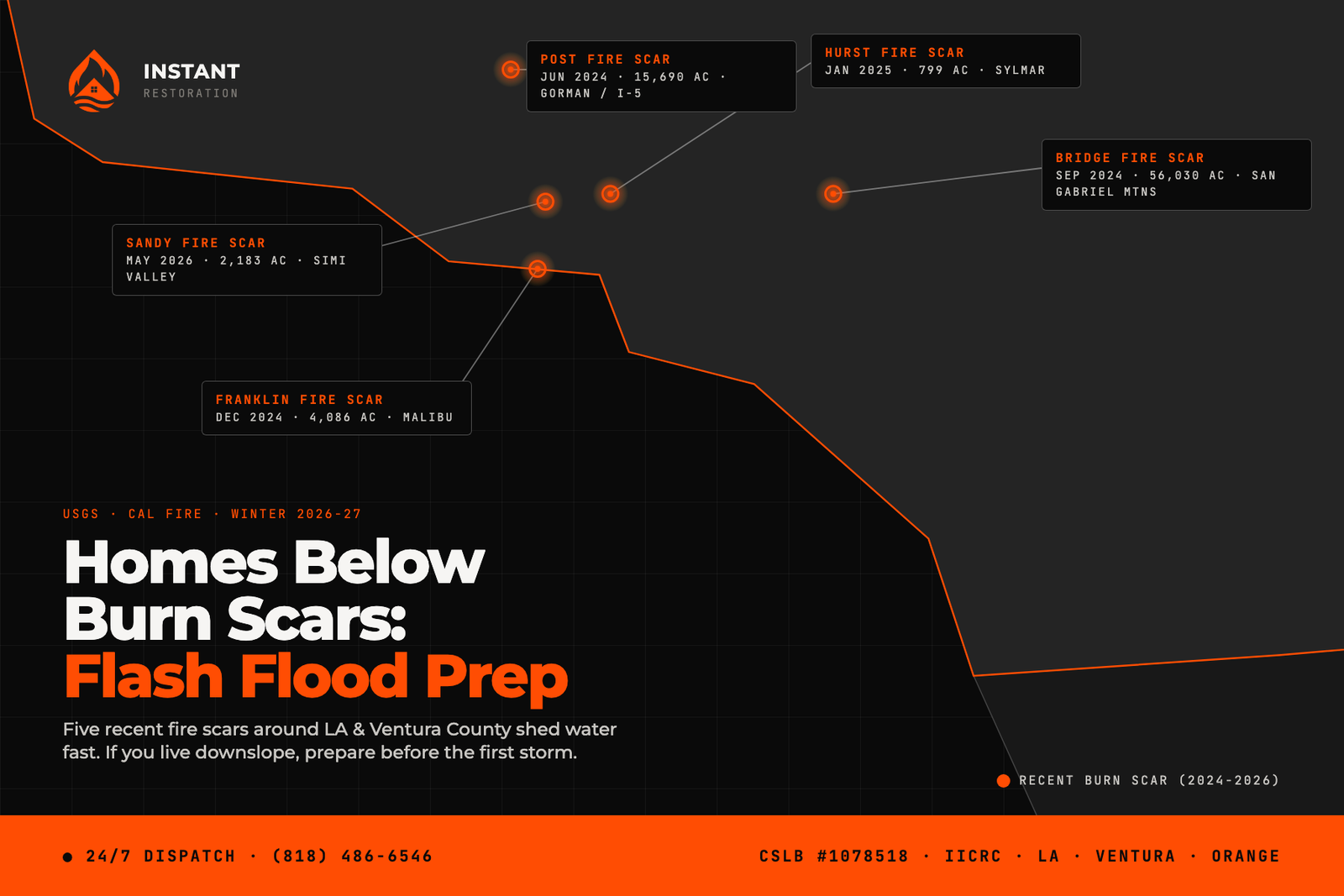
If your home sits below or downslope of a recent burn scar, flash flood preparation is not the same as normal rain prep — and the window to do it is before the first storm, not during it. Burned hillsides shed rain almost instantly instead of absorbing it, and the runoff picks up ash, soil, and rock as it accelerates. The U.S. Geological Survey has documented post-fire debris flows starting on fresh scars at rainfall rates as low as roughly half an inch per hour — a fairly ordinary Southern California winter storm. Five recent fire scars ring LA and Ventura County right now — Post, Bridge, Franklin, Hurst, and Sandy — on top of the Eaton and Palisades scars we’ve covered separately. Here’s the checklist we give homeowners below any of them.
Why do burned hillsides cause flash floods?
Two things happen to a hillside in a fire. The vegetation that intercepted rain and held soil in place burns off. And intense heat can leave a water-repellent layer near the soil surface, so rain that a healthy slope would drink runs off nearly instantly. The result: a storm that would have been an inconvenience produces fast-moving runoff loaded with ash, mud, and debris — sometimes a full debris flow that moves rock and vehicles.
The risk doesn’t end when the hills turn green. According to the USGS Landslide Hazards Program, burned watersheds remain prone to flash flooding and debris flows for roughly two to five years after a fire while soils and vegetation recover. That means every scar on the map below stays a winter hazard through at least this rainy season — and with a very strong El Niño forecast for winter 2026-27 (our El Niño preparation guide covers that side of the story), the storms and the scars are converging in the same winter.
Which burn scars threaten homes this winter?
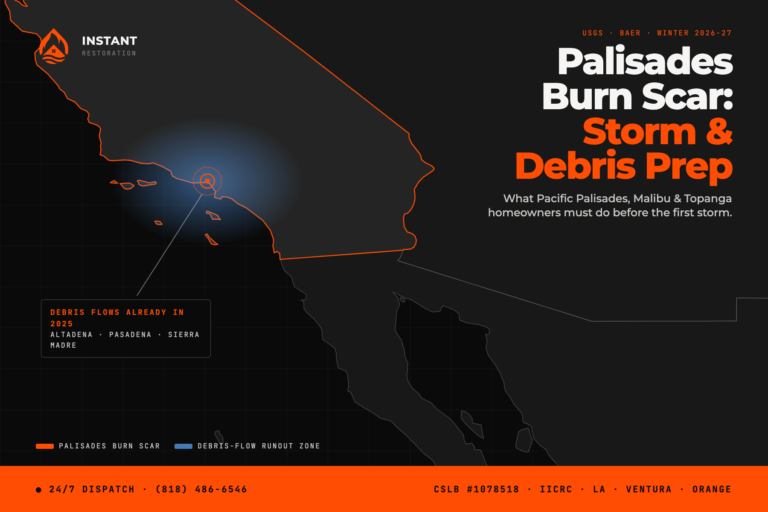
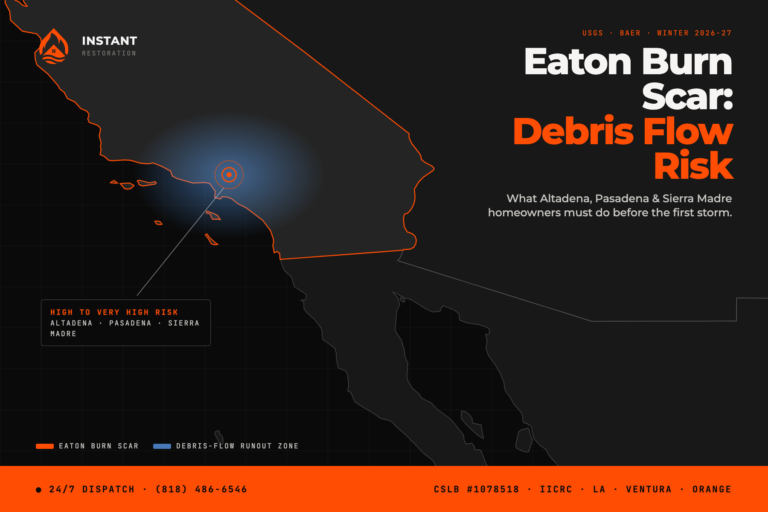
The two January 2025 scars have their own detailed guides — Eaton (Altadena & Pasadena) and Palisades (Pacific Palisades & Malibu). Beyond those, five more recent scars sit above inhabited slopes in our service area:
- Post Fire (June 2024) — 15,690 acres around Gorman and the I-5 corridor, reaching Pyramid Lake. Watch: canyon drainages toward Hungry Valley and the Grapevine.
- Bridge Fire (September 2024) — 56,030 acres in the San Gabriel Mountains, the largest scar on this list. Watch: foothill communities below the Angeles front country, Wrightwood and Mt. Baldy drainages.
- Franklin Fire (December 2024) — 4,086 acres in Malibu around Malibu Creek. Watch: canyon mouths along PCH — the same pattern as the Palisades scar next door.
- Hurst Fire (January 2025) — 799 acres above Sylmar. Small, but directly above San Fernando Valley neighborhoods.
- Sandy Fire (May 2026) — 2,183 acres near Simi Valley, the freshest scar in the region. First-winter scars shed the most debris.
Acreages are CAL FIRE final numbers. If you’re not sure whether your street drains a burned watershed, look uphill: if the slopes above you burned in the last five years, plan as if they did.
The before-the-first-storm checklist
- Sandbags — get them now, not the day of the warning. LA County Public Works distributes free sandbags at fire stations; Ventura County fire stations do the same seasonally. Place them to steer water away from doors, garage openings, and low vents — a chevron pattern that redirects flow beats a straight wall that tries to stop it.
- Clear the paths water already uses. Gutters, downspouts, yard drains, and the street gutter in front of your home. A clogged 4-inch drain is the difference between water moving past your house and water moving into it.
- Walk your uphill property line. Note where runoff entered in past storms. K-rails, sandbags, and plywood deflectors go on the uphill side, before the rain.
- Check your insurance now — there’s a waiting period. Standard homeowners policies do not cover flood or debris-flow damage; that’s a separate flood policy through the National Flood Insurance Program, and NFIP policies typically take 30 days to go into effect. If you’re below a scar and uninsured for flood, the time to fix that is a month before you need it.
- Photograph your home while it’s dry. Exterior, grading, drains, interior floors. If you ever file a claim, before-and-after documentation is the backbone of it.
- Know your trigger to leave. Debris flows arrive in seconds, not hours. If a Flash Flood Warning names your burn scar, treat it like an evacuation order, not a suggestion.
What should you do during a flash flood warning?
Move cars out of the drainage path, get people and pets upstairs or uphill, and stay away from the downhill side of the house. Do not try to reinforce sandbags mid-storm. And the rule that saves lives every California winter: never walk or drive through moving water — six inches moves an adult, a foot moves a car, and debris-laden water is heavier and faster than it looks.
After the water: what cleanup actually involves
This is what that looks like on a real job — a Los Angeles basement after the February 2024 storms. The water had already receded; the mud stayed, boot-deep, around the furnace:
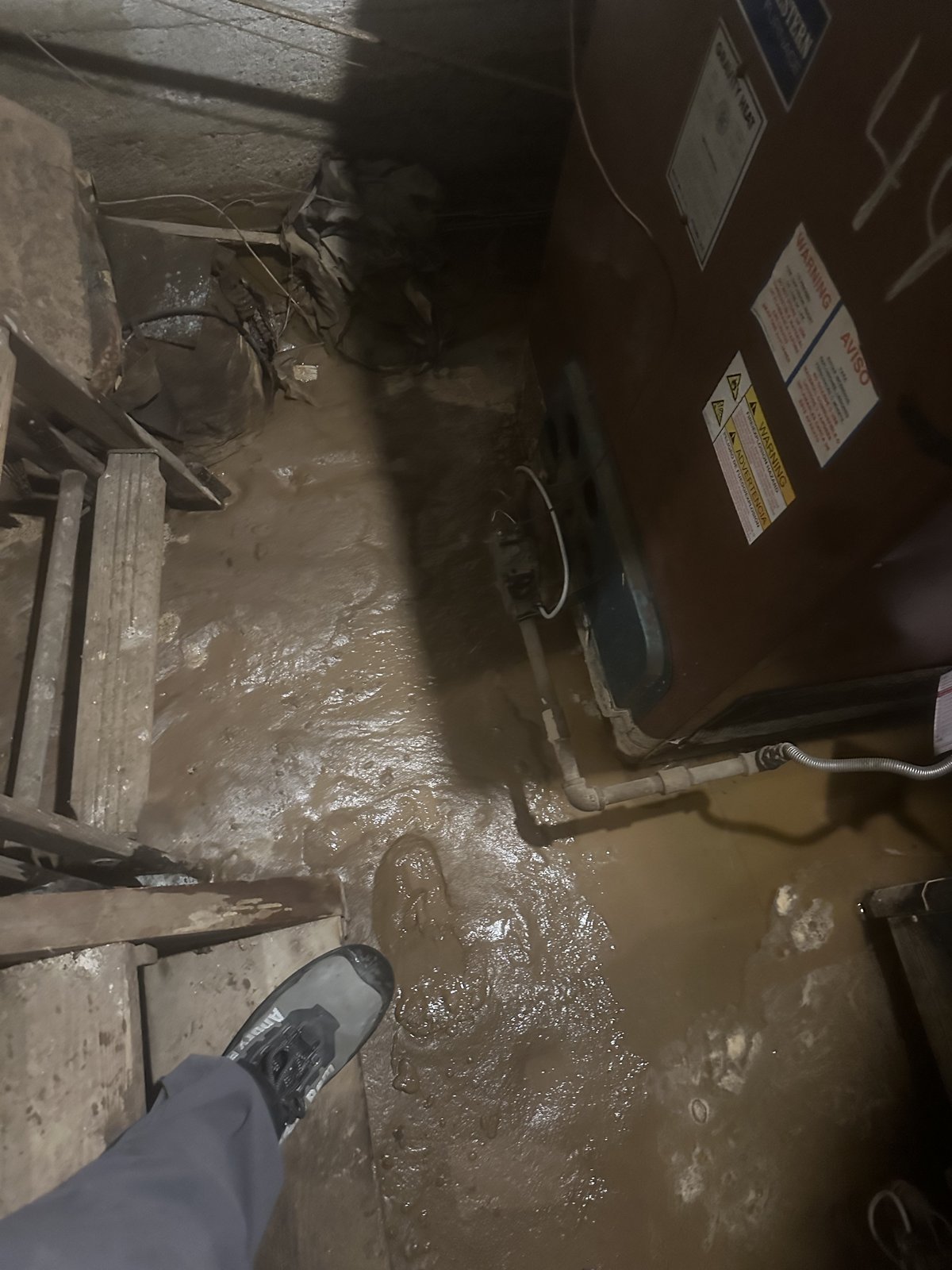
Storm and debris-flow damage is flood damage cleanup — a different job from a burst pipe. The water is Category 3 (contaminated with soil, ash, and whatever the hillside carried), which means affected porous materials get removed rather than dried, and the mud itself is often the bulk of the work. Two things matter in the first hours: document everything before touching it, and get standing water and saturated mud out fast — mud holds moisture against framing and turns a flood job into a mold job within days. We run this work across Ventura County and all of LA and Orange County, 24/7.
If storm water or mud gets into your home this winter, call us at (818) 486-6546 — we answer 24/7, and the sooner extraction starts, the more of your home stays original.
Oren Gedalia, Owner — CSLB #1078518