

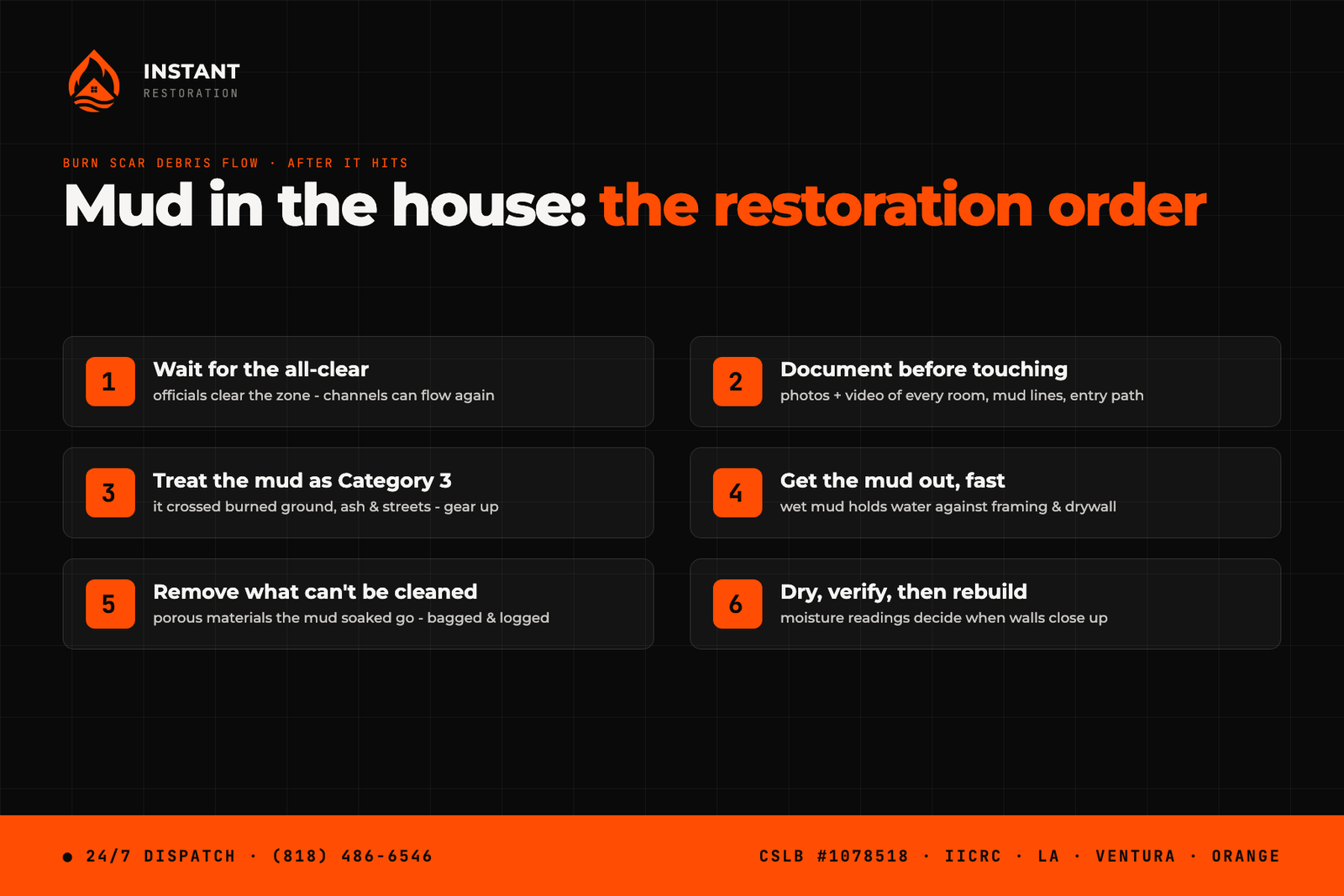
If a debris flow has reached your home, here’s the order that protects your family, your insurance claim, and the building itself: stay out until officials clear the area, document everything before anything moves, treat the mud as contaminated, and get it out and the structure drying within days, not weeks. Burn scar debris flow restoration in Los Angeles is different from an ordinary water cleanup for two reasons: what’s in the material, and how fast wet mud traps moisture against framing and drywall. This guide walks through what happens after a flow hits, from the first walk-through to the day the walls close back up, for homeowners below the Eaton and Palisades burn areas and any other recent scar.
Is it safe to go back inside after a debris flow?
Not until the people running the evacuation say so. Debris flows rarely come once. A burned channel that ran during one burst of rain can run again with the next, and the USGS Landslide Hazards Program tracks exactly this: burned watersheds respond to rain that would never have moved the same slope before the fire. The storm that brought the mud may not be the last one this season.
When you are cleared, go in daylight with boots, gloves, and an N95 mask. Look before you step. Cracks in walls or the slab, doors that suddenly stick, a wall bowed on the uphill side, or mud piled high against an exterior wall are all reasons to stay out and get a structural engineer or your city’s building department to look first. Only shut off power at the main if you can reach the panel without standing in water or mud; otherwise call the utility. If you smell gas, leave and call from outside.
What should you document before cleanup starts?
Cleanup erases evidence, and with debris flows the evidence decides a lot. Before a single shovel of mud moves:
- Wide shots of every room, then close-ups. Floors, walls, contents, appliances.
- The mud line. Photograph the high-water or high-mud mark on walls with a tape measure in the frame.
- The entry path. Where the material came in: the garage door, a slider, a window well, under a door. Shoot it from outside too.
- How the material looks. Liquid and soupy, or heavy and packed? For insurance, a flowing mudflow and a sliding mass of earth can be treated very differently. Our guide to whether insurance covers mudslide and debris flow damage explains why.
- A narrated video walk-through with the date spoken at the start.
Don’t throw out damaged belongings before the carrier has seen them or agreed in writing. Photograph them, list them, and where practical keep a sample.
Why is debris-flow mud treated as contaminated water?
The IICRC S500 standard, the reference restoration crews work from, classifies water that arrives from outside across the ground as Category 3: grossly contaminated. Debris-flow material qualifies several times over. It crossed burned ground carrying ash and residue from whatever burned upstream, then streets, storm drains, and yards. Handle it that way. No bare hands, no kids or pets in the area, and no household fans blowing across it, because dried fines go airborne and spread through the house. A household shop vac does the same thing through its exhaust.
The same standard shapes what stays and what goes. Porous materials that soaked up Category 3 water, such as carpet and pad, drywall that wicked above the mud line, insulation, and particleboard cabinets, are generally removed rather than cleaned. Framing, concrete, tile, and other hard surfaces can usually be cleaned, treated, and dried in place.
What does burn scar debris flow restoration actually involve?
Every house is different, but the sequence doesn’t change much:
Safety, access & documentation
Walk-through once the area is cleared, photos and starting moisture readings logged, utilities confirmed safe, undamaged rooms sealed off and protected.
Bulk removal & extraction
Shovels and wheelbarrows first, then extraction of the remaining water and slurry. Contaminated contents bagged and logged for the claim.
Flood cuts & removal
Drywall cut above the wicking line, wet insulation, flooring, and ruined cabinetry removed so the framing is exposed.
Clean, treat, dry
HEPA vacuuming, cleaning of framing and hard surfaces, antimicrobial application, then dehumidifiers and air movers with readings taken every visit.
Rebuild
Walls close only when moisture readings confirm the structure is dry. Then drywall, flooring, cabinets, and finishes.
That first half is our flood damage cleanup work, and the drying and rebuild run under our water damage restoration service. It’s one licensed crew from the first shovel of mud to the final walkthrough, which matters when the same documentation has to follow the job all the way through the claim.
How fast does mold become a problem after mud gets in?
Fast. The EPA’s guidance on mold and moisture is to dry water-damaged areas and items within 24 to 48 hours to prevent mold growth. Mud makes that window almost impossible to hit with fans alone, because a layer of wet sediment against a wall acts like a poultice, feeding moisture into the drywall and framing behind it. That’s why the order above puts mud removal and flood cuts before drying, never after.
If you’re already past two days, the house isn’t lost. It usually means more material comes out and antimicrobial treatment matters more. If growth is already visible, that part of the job becomes mold remediation, done under containment, with clearance confirmed by an independent third party rather than by the crew that did the work.
Will insurance pay for debris flow damage?
It depends on the policy and the cause, and the answer is more hopeful after a wildfire than most homeowners expect. Standard homeowners policies generally exclude both earth movement and flood. An NFIP flood policy covers mudflow. And in California, when a slide comes off a recent burn scar, the fire itself may be treated as the cause, which can bring the homeowners policy back into play. The full breakdown is in our mudslide and debris flow insurance guide.
To be clear about our lane: we’re restoration contractors, not public adjusters or insurance advisors. What we do is document and support. Photos, moisture logs, and a line-item scope of what was damaged and what we found. File promptly even if you expect a denial, and let the evidence carry the argument.
Is the danger over once the mud is out?
No. The same channel can run again in the next storm, and recovery of a burned slope takes several rainy seasons. Once the house is cleaned out, prepare it for the next one: sandbags angled to steer flow around the structure, private drains and the curb inlet cleared, and county emergency alerts set for your zone. Our flash flood preparation guide for homes below burn scars covers the full checklist. Homeowners below the Eaton burn area in Altadena and Pasadena, and below the Palisades burn area along the coast, are working through the same season at the same time.
Mud in the house, or water still coming in? Call (818) 486-6546. We answer 24/7 across Los Angeles, Ventura, and Orange County, and the first thing we do is the documentation your claim will need.
Oren Gedalia, Owner — CSLB #1078518