Skip to content
WOODLAND HILLS HQ OPEN 24/7 IICRC-CERTIFIED TECHNICIANS CSLB LICENSED ★ 5.0 119 REVIEWS WATER FIRE SMOKE MOLD SERVING LA VENTURA ORANGE COUNTY
Woodland Hills HQ Encino Smoke damage restoration · Los Angeles County About 22 min drive from our HQ [ Service area · Los Angeles County ] Instant Restoration · 24/7 · CSLB #1078518
Encino, CA · Smoke Damage · IICRC S700

Smoke Damage Restoration in Encino, CA

Smoke damage from a structure fire, kitchen fire, or regional wildfire affecting your Encino property? We’re based in Woodland Hills, about 12 minutes away, and we handle active smoke decontamination — IICRC S700 protocols, HVAC cleaning, odor neutralization, content cleaning. The same team handles any rebuild on our CSLB #1078518 B-General license, HAZWOPER-trained for older Encino homes.

⚡ Call (818) 486-6546
~12min
Drive from Woodland Hills HQ
IICRC
Certified technicians
24/7
We answer any hour
5.0★
119+ Google reviews
★ 5.0 from 119+ reviews ·CSLB #1078518 · B-General Building · HAZWOPER-trained crews ·IICRC-certified technicians ·Local Woodland Hills HQ
Section 01 · First 15 minutes

First 15 minutes — what to do before we arrive.

While we’re en route, this is what protects your property and your insurance claim.

Don’t run the HVAC system.

Every cycle pulls smoke-saturated air from the attic and ducts and redistributes it through the rest of the house. Turn it off completely until we assess.

Don’t wipe soot or ash from surfaces.

Both are acidic. Wiping spreads the acid and embeds it deeper. The marks that look like dust are actually corroding the surface underneath.

Don’t try home air purifiers as a fix.

Standard purifiers handle airborne particles but don’t address smoke that has settled into HVAC ducts, attic insulation, or porous surfaces. They mask the symptom temporarily without removing the source.

Don’t wash smoke-affected clothing in your home washer.

Home washing sets smoke odor permanently into fabric. Specialty cleaning is required.

Open windows for short ventilation cycles only.

Brief airing-out helps with airborne smoke, but won’t address embedded contamination — and if outdoor air quality is still poor, you’re making it worse.

Document with photos.

Wildfire smoke claims are often filed weeks or months after the fire — early documentation matters.

Contact your insurance carrier.

Wildfire smoke remediation is often filed as a separate claim category, even when the home didn’t burn — coverage depends on your policy.

Section 02 · Why Encino

Why smoke damage in Encino is its own problem.

Three factors stack on top of each other — regional wildfire smoke reaches Encino homes that never burned, leaving days of smoke and ash exposure behind.

Regional wildfire smoke infiltration.

Even homes that don’t burn take heavy smoke and soot during regional fires. The January 2025 Palisades Fire burned the Pacific Palisades, Malibu, Topanga, and Brentwood corridor — close enough that smoke and ash reached Encino for days, and HVAC systems pulled it into homes. Encino Hills, Royal Oaks, and south of Ventura Blvd all faced the smoke even though the active burn was miles away.
Kitchen, electrical, and chimney smoke.

A contained kitchen fire still pushes smoke through the HVAC into every room. Electrical fires leave protein and plastic residues that need specialized S700 cleaning, and Encino’s older Mediterranean and Spanish homes take chimney smoke from cracked flue tiles.

HVAC contamination that recirculates for months.

Even a brief regional smoke event leaves residue in ducts, coils, and filters that recirculates odor for months without proper S700 remediation. Smoke is acidic particulate — every hour it sits, it embeds deeper and bonds with porous materials.

Where smoke and ash actually hide:

HVAC ductwork and air handler.

The biggest single concentration point. Smoke settles into ducts and lives there indefinitely, redistributing into the house every time the system runs.

Attic insulation.

Fiberglass and blown-cellulose attic insulation absorb smoke and ash through every penetration in the ceiling. Often requires full removal and replacement after major exposure events.

Wall cavities.

Smoke migrates through electrical outlets, recessed lighting, and any other ceiling/wall penetration into wall cavities. Even cleaned interior surfaces continue to off-gas if the cavity behind isn’t addressed.

Soft furnishings.

Curtains, upholstery, carpet, bedding. All porous and all absorb smoke. Often requires off-site professional cleaning.

Closets and storage areas.

Closed spaces trap smoke. Clothing, linens, and stored items often need full inventory cleaning.

Books, papers, and electronics.

Porous paper and complex electronics both absorb smoke. Each requires specialty cleaning approaches.

Wood surfaces.

Hardwood floors, cabinets, doors, and trim. Acidic smoke residue continues etching the finish until properly cleaned and resealed.

Section 03 · Our process

Our IICRC S700 decontamination process.

Every smoke job follows IICRC standards for fire and smoke restoration.

Assessment (Day 1)

  • Identify smoke source and exposure type (wildfire ash, kitchen fire, electrical fire, etc.)
  • Map affected areas including hidden cavity and HVAC contamination
  • Document for insurance with photos, scope, and contamination level
  • Independent third-party testing when required (a hygienist you hire — we do not test)

HVAC decontamination

  • Full duct cleaning with HEPA filtration
  • Air handler cleaning and component replacement where needed
  • Filter replacement and system sanitization

Attic and cavity remediation

  • Insulation assessment and removal where smoke-saturated
  • Replacement with new insulation
  • Sealing of penetration points to prevent re-contamination

Surface cleaning

  • Soot removal from walls, ceilings, trim, hard floors
  • Specialty cleaning of wood surfaces and finishes
  • Treatment of materials that can’t be replaced

Contents

  • Inventory of affected contents
  • Off-site professional cleaning of salvageable items
  • Documentation of unsalvageable contents for insurance

Final deodorization

  • Thermal fog or ozone treatment as appropriate
  • Independent third-party clearance (a hygienist you hire)
  • Clearance documentation from the hygienist
Section 04 · Why local depth matters

The smell fades. The contamination doesn’t.

Surface-cleaning addresses what you can see. The remediation work happens where the smoke actually settles.

Surface-cleaning isn’t remediation.

Wildfire smoke in Encino isn’t a ‘wait and see if the smell fades’ problem — the smell fades, but the contamination doesn’t. Attic insulation acts as a giant absorbent sponge; without replacement, smoke keeps off-gassing into the house every time the HVAC runs. Wildfire smoke remediation is one of our core services — we document the loss thoroughly to support a clean claim file.

Section 05 · Why Encino calls us

Why Encino homeowners call us for smoke damage.

One local, licensed team that addresses the hidden contamination — not just the surfaces you can see.

Local team — 12 minutes from HQ.

Our HQ is in Woodland Hills, about 12 minutes away — and we answer 24/7.

Wildfire smoke specialization.

We handle wildfire smoke remediation across the Valley. We document the exposure thoroughly for your carrier and adjuster — coverage depends on your policy.

IICRC-certified technicians.

Industry standards for fire and smoke restoration — S500 for any water component, S520 for any resulting mold.

HVAC and attic depth.

Most smoke damage hides in the HVAC and attic. Surface-only cleaning leaves the contamination in place — we address the hidden sources.

CSLB #1078518 B-General Building Contractor.

When smoke remediation needs reconstruction (drywall, insulation, finish work), the same team handles it. No second contractor.

HAZWOPER-trained for older Encino homes.

For pre-1980 Encino homes where smoke-damage cleanup may expose asbestos in original drywall, popcorn ceilings, pipe wrap, or floor-tile mastic. If asbestos is suspected, we stop and bring in a licensed abatement firm.

Insurance coordination.

Wildfire smoke claims are often filed weeks or months after the fire. We document the exposure properly and share it with your carrier.

Section 06 · Recent work

Recent work — what a smoke job looks like.

Real photos from our own jobs — and what a smoke and soot damage call in Encino involves.

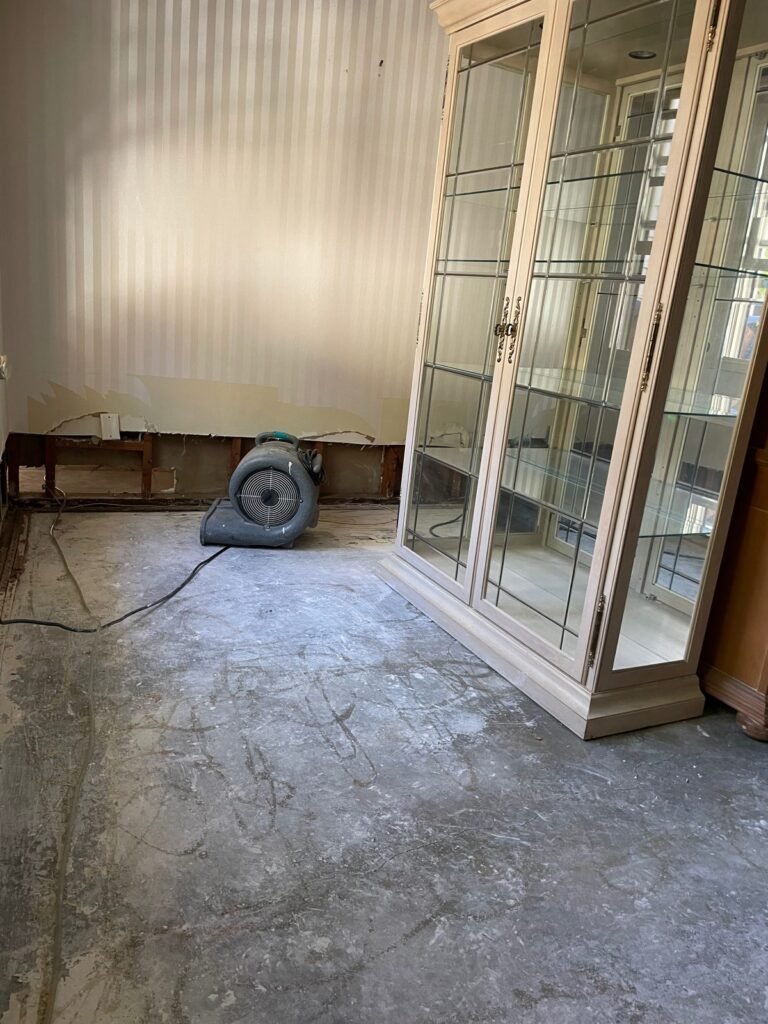
Instant Restoration job (structural drying stage) in West Hills, CA

Encino — smoke damage restoration: what the work looks like.

The photo is from an Instant Restoration job (structural drying stage) in West Hills, Los Angeles County: air mover on stripped floor, flood-cut wall base, empty display cabinet. On a typical smoke and soot damage call in Encino the same licensed crew will assess residue on every surface, clean soot with the right method for each material, treat odor at the source rather than masking it, clear HVAC and contents where needed, document the loss for the insurance file, and rebuild with the same crew. We are a California-licensed general building contractor (CSLB #1078518), bonded and insured, and we answer 24/7.

We neutralize smoke odor at the source and clear the HVAC — not mask it.

Section 07 · Common questions

Frequently asked questions.

The questions we hear most about smoke damage in Encino.

How fast can you respond to smoke damage in Encino?
We answer 24/7 — and we’re based in Woodland Hills, about 12 minutes away. For active smoke contamination every hour matters — soot embeds deeper into materials over time.
Did the Palisades Fire cause smoke damage in Encino?
The January 2025 Palisades Fire burned the Pacific Palisades, Malibu, Topanga, and Brentwood corridor — it didn’t directly burn Encino, but smoke and ash reached the city for days and HVAC systems pulled it into homes. Wildfire smoke damage without any structural fire is its own restoration scope — S700 decontamination, HVAC cleaning, and odor neutralization — and we handle it across the Valley.
Can I just clean smoke damage myself?
Light surface smoke, maybe. But HVAC contamination, embedded smoke in porous materials, protein smoke from kitchen fires, and wet smoke from plastic fires all require S700 protocols. DIY usually leaves residual odor that returns months later when humidity rises or the HVAC runs.
How do I know if my HVAC is contaminated with smoke?
If the smoke event happened with the HVAC running, assume it’s contaminated until proven otherwise. Signs: persistent odor when the HVAC runs, visible residue on vents or filters.
Will my insurance cover smoke damage from a regional wildfire?
Coverage depends on your policy and on whether the damage is traceable to a specific wildfire. When covered, the scope can include HVAC decontamination, surface cleaning, content cleaning, and odor neutralization. We document the loss to your carrier’s requirements.
What’s the difference between smoke types and why does it matter?
Dry smoke (wood, paper) cleans with dry chemical sponges; wet smoke (plastics, rubber) needs solvents; protein smoke (kitchen) needs enzyme cleaners; fuel/oil smoke needs petroleum-based solvents. The wrong protocol leaves residual odor that returns.
Do you handle content cleaning for smoke damage?
Yes — on-site for some items, pack-out to our facility for others. Ozone or hydroxyl treatment for soft contents, ultrasonic and surface cleaning for hard contents, and specialty partners for documents, art, and electronics.
How long does Encino smoke restoration take?
Light scope: 3–7 days; moderate: 1–3 weeks; heavy scope with content pack-out and HVAC work: 3–6 weeks. We give you a real timeline at scope approval.

See all questions →

Nearby cities

Smoke damage restoration in nearby cities.

We run smoke damage restoration across the Valley under one license — mitigation through rebuild. Click into a nearby city for its fast local response.

Section 08 · Get help now

Smoke damage at your Encino property? The smell fades — the contamination doesn’t.

Wildfire smoke in Encino isn’t a “wait and see if the smell fades” problem — the smell fades, but the contamination doesn’t. Call Instant Restoration for a free assessment, fast local response across the Valley, and full IICRC smoke remediation. We answer 24/7, and we’re based in Woodland Hills, about 12 minutes from Encino. We remediate and rebuild — one team, one timeline, one accountable phone call away.

(818) 486-6546 ⚡ Call now Free on-site assessment · written scope · no obligation