
Usually yes, if the water arrived suddenly and by accident. Standard California homeowners policies are built around that one distinction. A supply line that bursts on a Tuesday is the kind of loss they’re written to pay for. A drip that ran behind a vanity for eight months is the kind they’re written to exclude. And flood, meaning water that rises from outside and comes in, sits outside a homeowners policy altogether. That’s the short version of whether insurance covers water damage in California. The longer version matters more, because the same leak can land on either side of that line depending on how long it ran and what you can show about it.
What is the basic rule for water damage coverage?
Insurers call it sudden and accidental. The idea is that a policy pays for an event, not for the slow decline of a building. A pipe that lets go is an event. A fitting that wept for a year while the cabinet underneath quietly rotted is maintenance, and maintenance belongs to the homeowner.
Two things follow from that. First, your policy language governs, not a general article, and policies differ. The California Department of Insurance’s residential insurance guide is the state’s own plain-language walkthrough of what a homeowners policy does and doesn’t cover, including water damage and flood, and it’s worth reading before you need it. Second, your insurer decides what is covered. We are restoration contractors, not insurance advisors, and nothing here is a prediction about your claim.
What water damage is usually covered?
These are the losses that tend to fit the sudden-and-accidental test:
- A burst pipe or supply line. The classic covered loss, including the braided hose under a sink or behind a washing machine.
- A water heater that fails. A tank that splits and empties is sudden. A tank that has been seeping at the base for a year is usually not.
- An appliance that overflows or breaks. Dishwashers, refrigerator ice lines, washing machines.
- A toilet or tub overflow. Sudden and accidental, as long as it was not a known, ignored problem.
- Rain that enters through storm damage. If wind opens the roof and rain follows, most policies treat the water as part of the storm loss. Rain coming through a roof that was already failing is a different conversation.
- Water used to put out a fire. Typically covered as part of the fire loss.
In all of these, the covered thing is the damage, not the broken part. Many policies pay to repair the wall and the floor, and to open up what has to be opened to reach the pipe, while leaving the pipe itself to you.
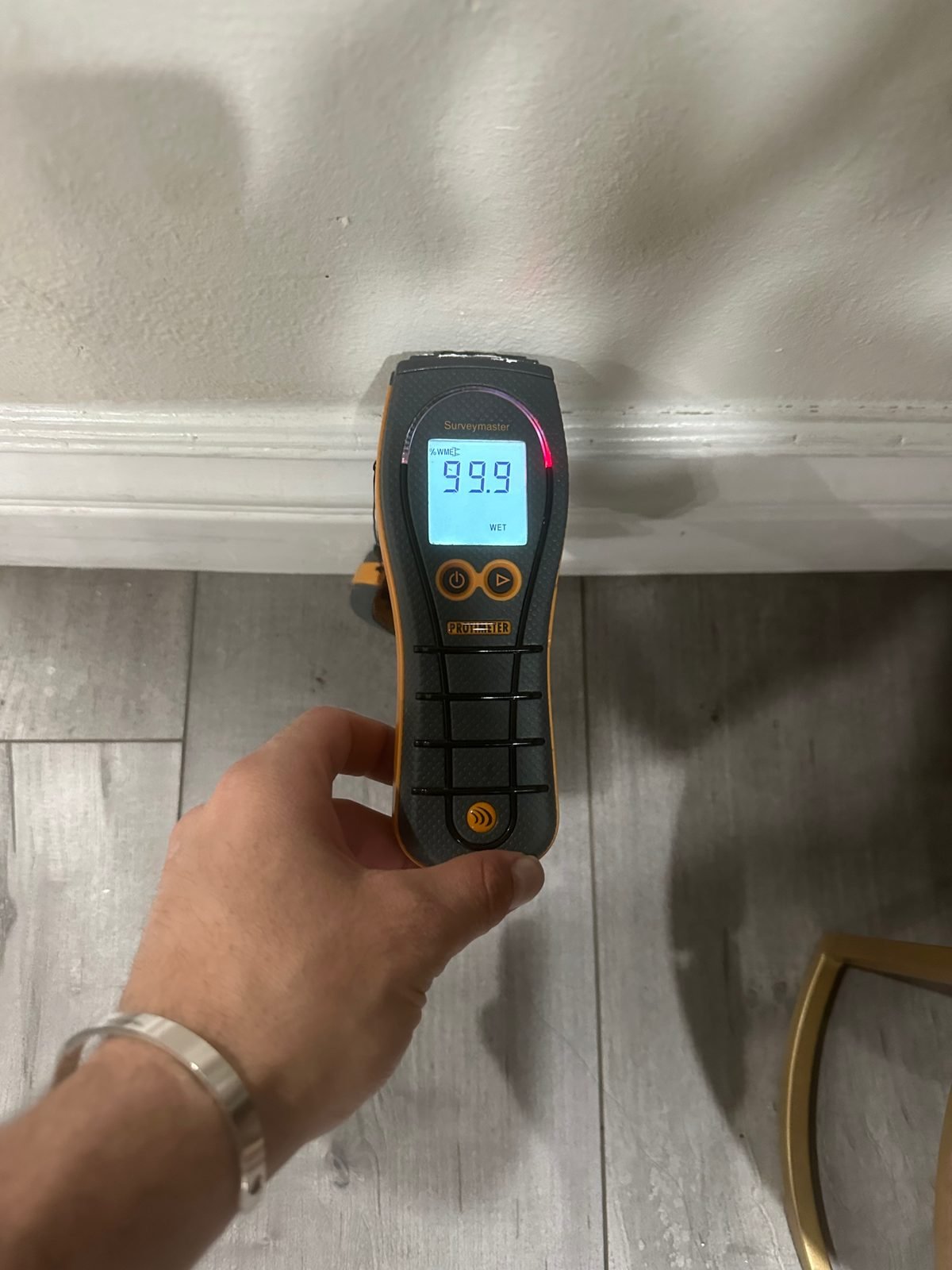
A moisture meter reading on a wall just above the baseboard, on an Oxnard job. A reading like this one, dated and photographed, is the kind of record that goes into a claim file.
What does a homeowners policy usually exclude?
The exclusions are where most denials come from, and they’re not arbitrary. They mostly describe damage that built up over time.
- Continuous or repeated seepage. Many policies exclude leaks that ran over a period of weeks or months, whether or not anyone knew about them.
- Wear, rot and deterioration. An aging shower pan that finally lets go is often treated as a maintenance item.
- Deferred maintenance. A problem you knew about and did not address is a hard claim to make.
- Flood and surface water. Excluded from the standard policy entirely. See the next section.
- Earth movement, including mudflow and debris flow. A separate exclusion with its own rules, which matters a great deal below a burn scar. We walk through that one in our guide to mudslide and debris flow coverage in California.
- Sewer and drain backup. Often excluded unless you bought an endorsement for it. It’s usually inexpensive and worth asking your agent about.
Is flood damage covered by homeowners insurance?
No. Flood is its own category and its own policy. Ready.gov’s flood guidance states that homeowner’s policies don’t cover flooding, and notes that it takes 30 days for a policy to go into effect. That second part is the one people learn too late: flood insurance bought when the forecast turns isn’t in force for the storm that prompted it.
The distinction can feel arbitrary standing in a wet house. Water from a pipe inside the wall is a homeowners claim. The same depth of water that came across the yard and under the door is a flood claim. The cleanup work is similar, and our flood damage cleanup crew handles both, but the coverage path is completely different, and so is the paperwork.
Does insurance cover the mold that grows after a leak?
Partly, usually, up to a limit. After the mold claims of the early 2000s, most carriers added a specific mold provision: if the mold resulted from a covered water loss, remediation is covered up to a dollar cap written into the policy. That cap is listed in your declarations page, and the amount varies widely between carriers. Mold that grew from an excluded cause, such as a long slow leak or ongoing humidity, is generally not covered at all.
This is the practical reason to move quickly on a wet house rather than waiting for an adjuster to walk it. Most policies also ask you to take reasonable steps to prevent further damage after a loss, which is why insurers generally expect drying to begin before anyone arrives in person.
Our guide to mold coverage in California goes deeper on the limits and the language. On the work itself: we do mold removal and remediation only. Clearance is done by an independent third party, never by the company that did the work. And on health questions, we are restoration professionals, not medical professionals. If anyone in the house has symptoms you’re worried about, talk to a doctor.
What should you do in the first hours to protect the claim?
The claim is built out of what you can show. In order:
- Stop the water and make the house safe. Shut the valve or the main. Stay away from wet electrical.
- Photograph everything before you move it. Wide shots of each room, then close-ups of the source, the damage and the water line on the walls. Date-stamped phone photos are fine.
- Don’t throw anything away yet. Damaged flooring, baseboard and contents are evidence until the adjuster has seen them or released them. Bag and set aside what has to come out.
- Report the loss. Call your carrier or agent and get a claim number.
- Start drying. Waiting makes the damage worse, which helps nobody, least of all you.
- Keep every receipt. Hotel, fans you bought, meals if you were displaced. Many policies include additional living expenses.
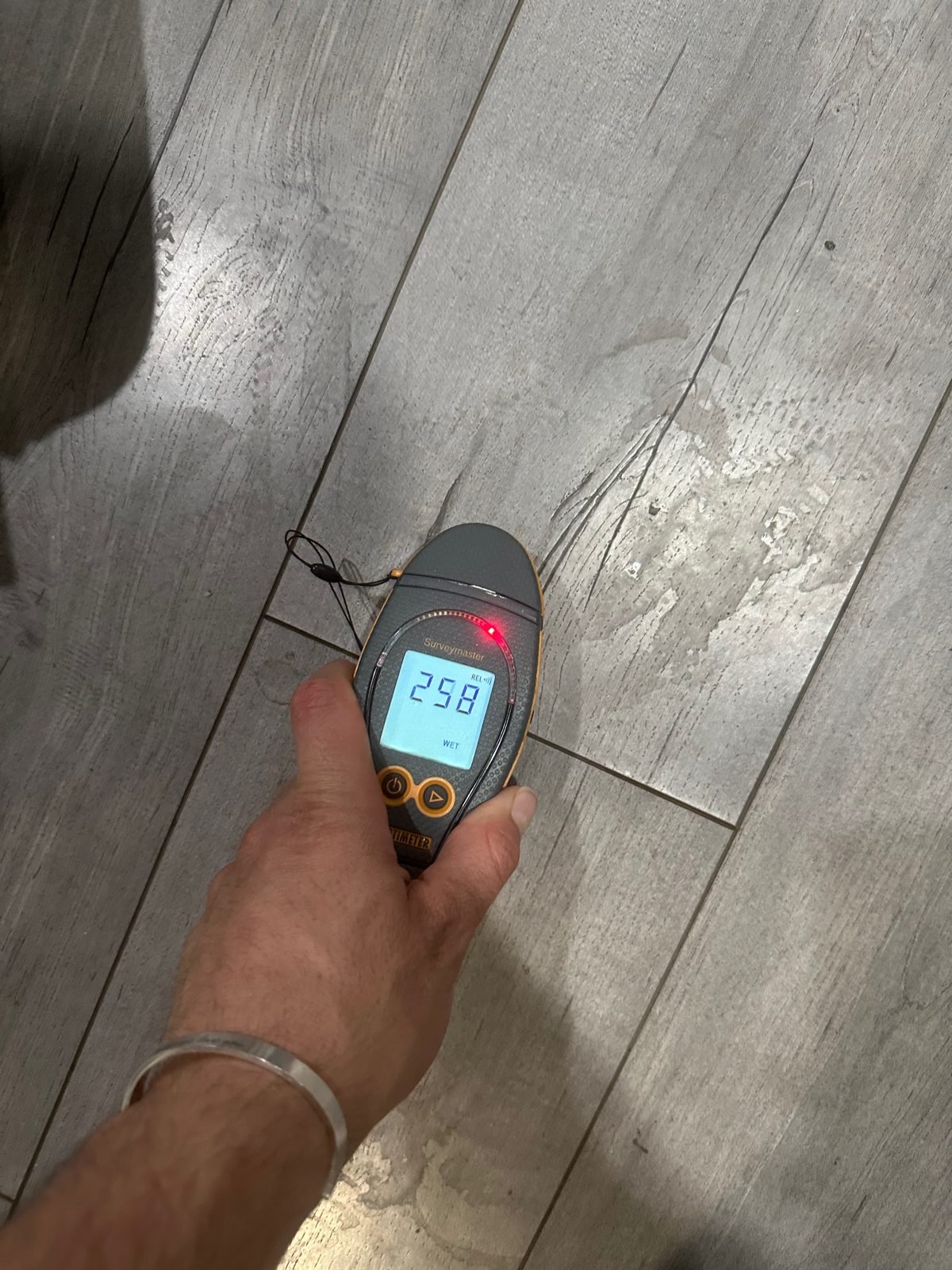
The same Oxnard job, reading the plank flooring. Staining is visible on the boards around the meter.
This is also where a restoration contractor earns their place in the file. Our water damage restoration crews photograph conditions on arrival, log daily moisture readings for every affected material, and produce a line-item scope in the format carriers expect. What we don’t do is speak for you with your carrier. We are not public adjusters, and we do not represent you in coverage discussions. We document what was wet, what we did and what it cost, and you or your adjuster take it from there.
Water damage in your home and not sure where the coverage lines fall? Call (818) 486-6546. We answer 24/7, we document everything from the first walkthrough, and you get a written scope and price before any work starts.
Oren Gedalia, Owner — IICRC-certified · CSLB #1078518