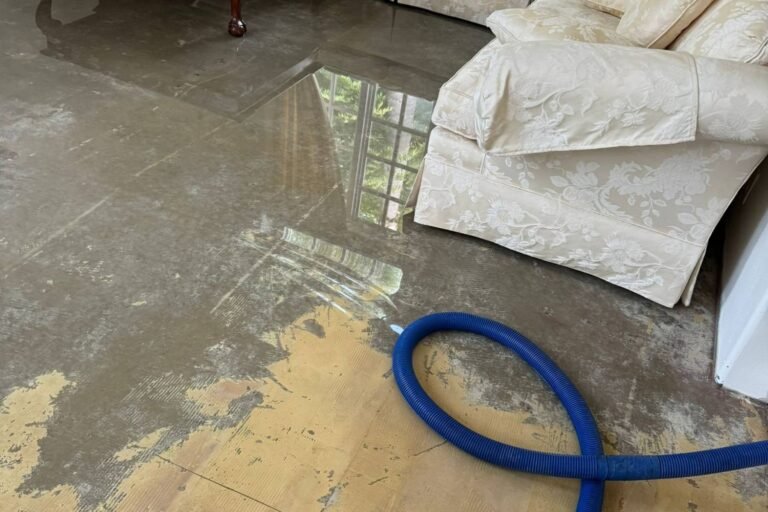

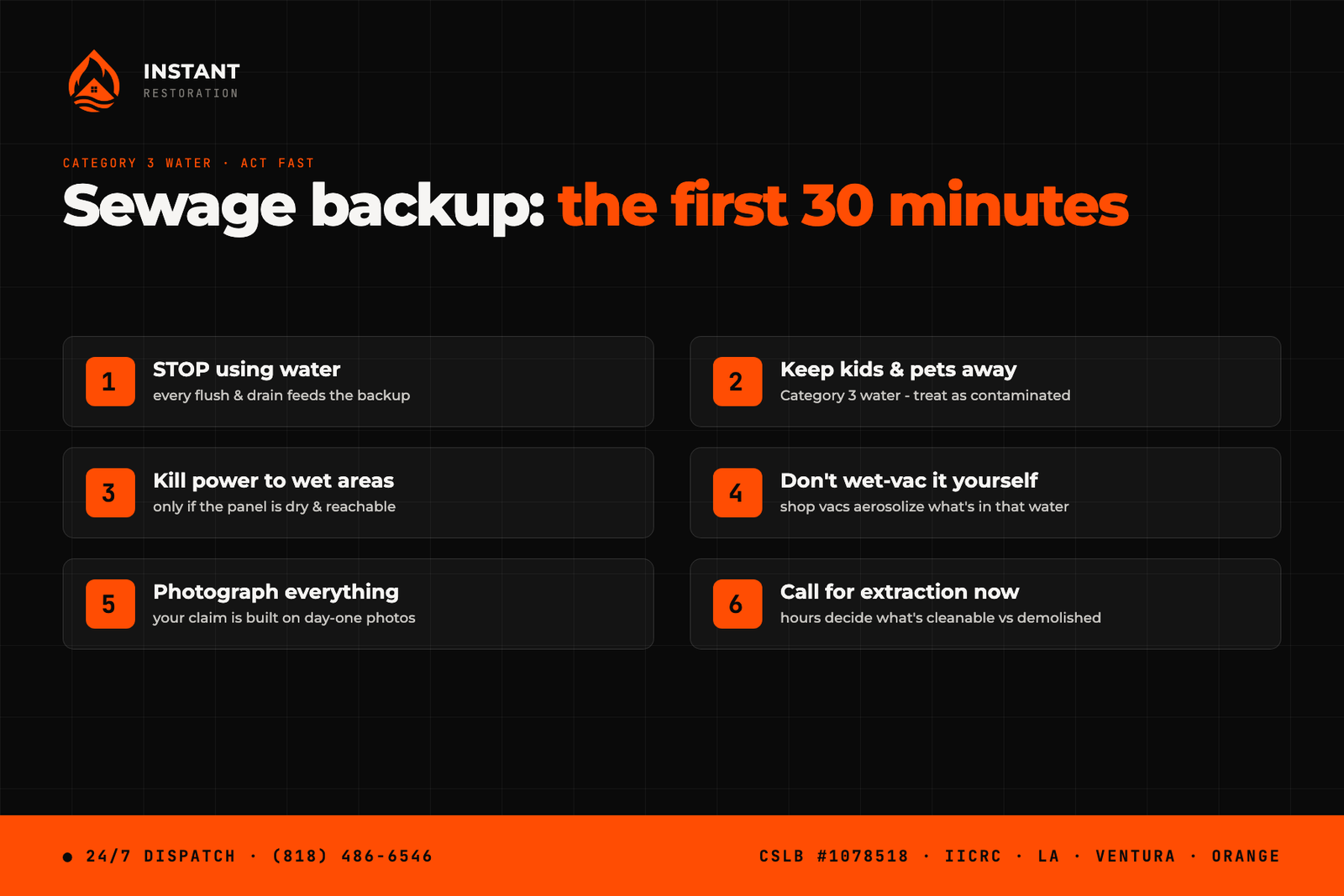
A sewage backup gets a different playbook than any other water emergency, and the first thing to know about what to do is what NOT to do: don’t wade in, don’t mop it up, and don’t put your shop vac anywhere near it. Sewage is what the restoration industry calls Category 3 water — water carrying contaminants that can make people sick — and the CDC’s guidance on contaminated water is blunt about the bacteria, viruses, and parasites it can carry. The immediate steps: stop using every drain and toilet in the house, keep children and pets away from the area, cut power to affected rooms if you can do it safely from a dry location, photograph everything, and get professional extraction moving — with sewage, the clock decides what gets cleaned versus what gets demolished.
What should you do in the first 30 minutes?
- Stop using water — everywhere in the house. Every flush, shower, and dishwasher cycle feeds the backup. If the blockage is in your main line, the water you use upstairs arrives in your hallway downstairs.
- Keep people and pets out. Close the door if there is one. Kids and animals are drawn to standing water, and this is the one kind of water in a house that genuinely earns the word hazardous.
- Kill power to the affected rooms — only if it’s safe. If the panel is dry and reachable without stepping in water, flip the breakers for the wet area. If not, leave it and tell the crew when they arrive.
- Do not mop, wet-vac, or fan it. A household shop vac isn’t sealed for contaminated water — it exhausts a fine mist of exactly what you don’t want airborne. A fan does the same job faster. This is the most common way a floor problem becomes an everything problem.
- Photograph and video everything before anything is touched. The claim — and there often is one — is built on day-one documentation.
- Call for extraction. Not Monday. Sewage that sits overnight soaks into drywall, cabinetry, and subfloor, and those materials generally can’t be sanitized — they get removed. Every hour shifts square footage from the “cleanable” column to the “demolition” column.
Why is sewage treated so differently from a burst pipe?
Restoration standards (IICRC S500) split water into three categories. Category 1 is clean supply water — a burst pipe, a failed fridge line. Category 2 has some contamination — washing machine discharge, for example. Category 3 is grossly contaminated water: sewage, plus anything that has flowed over ground or sat long enough to grow. The category decides the protocol. Clean water can often be dried in place; Category 3 means porous materials that absorbed it — carpet and pad, drywall that wicked it up, particleboard cabinets — are removed rather than dried, the space is cleaned and disinfected, and drying happens after the source of contamination is gone.
On the health side, we’ll say what we always say: we are restoration professionals, not medical professionals. If anyone in your home has been in contact with sewage water and feels unwell — especially stomach illness or an open cut that touched the water — that’s a call to your doctor. Our job is making the house safe again; the federal flood-safety guidance covers the personal-safety side well.
What causes sewage backups — and why do they spike in the rainy season?
- Tree roots — the classic in LA’s older neighborhoods, where clay sewer laterals from the 1950s-70s meet mature ficus and camphor roots. Roots enter at joints and slowly strangle the line.
- Grease and wipes — the slow-building clogs. “Flushable” wipes aren’t, and cooled grease narrows a line like plaque.
- Line breaks and sags — a settled or broken lateral holds waste until it doesn’t.
- Rain-driven surcharge — the seasonal one. When storms overwhelm municipal mains, the system can back up through the lowest opening available — which may be the floor drain or shower in your home. This is why backups cluster in exactly the storm weeks our first-storm checklist is built for, and why homes with below-street plumbing should ask a plumber about a backwater valve before the season peaks.
What does professional sewage cleanup involve?
Done to standard, sewage cleanup and sanitization runs: containment of the affected area, extraction of standing water and solids, removal of contaminated porous materials, cleaning and EPA-registered disinfection of everything that stays, drying to verified moisture targets, and only then rebuild. The order matters — disinfecting before removing soaked drywall is theater, and drying before disinfecting locks contamination in. It’s the same discipline as our water damage work, with the contamination handling layered on top; the speed logic from our first-24-hours guide applies double here.
Standing in a hallway you’d rather not describe? Call (818) 486-6546 — 24/7 across Los Angeles, Ventura, and Orange County. Extraction first, judgment never.
Oren Gedalia, Owner — CSLB #1078518