
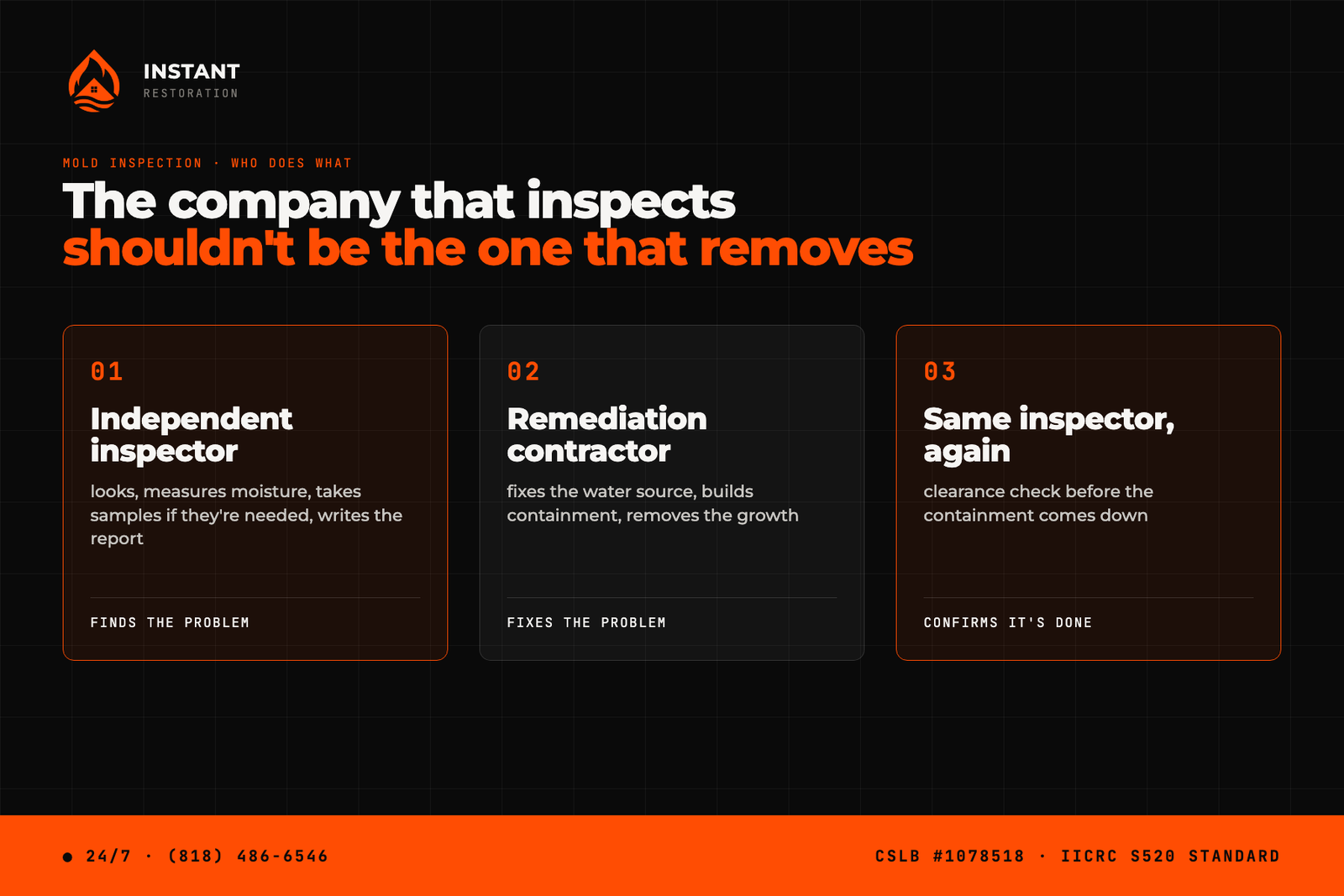
A legitimate mold inspection is done by an independent inspector, usually an industrial hygienist or a mold assessor, who has no stake in the removal job. They ask about the history of the house, look carefully room by room, and take moisture readings to find where water has been. They take samples only when a sample answers a real question, they compare indoor air with an outdoor sample taken at the same time, and they send what they collect to an outside lab. You get a written report that says what they found, where the moisture is coming from and what should be removed. When the work is done, the same inspector comes back to check it. Here’s what each step should look like, and how to spot a sales pitch.
Up front, so there’s no confusion about where we sit: we don’t inspect for mold and we don’t test for it. We’re a remediation company. From our mold removal and remediation page, here’s what we don’t do: Mold testing, Mold inspection, Air sampling, Surface sampling, Spore identification. Those belong to the independent inspector.
Why should the mold inspector be independent from the remediation company?
Because the inspector decides how big the job is, and later decides whether it was done right. If the same company does the inspection, the removal and the clearance, it’s writing its own scope and grading its own work. That leaves you with no outside check.
An independent inspector gets paid the same whether they find a closet’s worth of growth or a whole wall. That’s the point. On our jobs, clearance is always done by a third party, never by us.
What happens during a legitimate mold inspection?
A good inspection looks more like detective work than lab work. The samples, if there are any, come near the end. Here’s the usual order:
- Questions first. When did the leak happen, was it fixed, where’s the smell strongest. The history points the inspector at the right walls.
- A slow look, room by room. Under sinks, around showers, at window frames and baseboards, plus the attic, crawlspace and HVAC where they can be reached safely.
- Moisture readings. A moisture meter on walls, floors and framing, often with a thermal camera. Mold needs water, so finding the water finds most of the problem.
- A decision about sampling. The inspector should be able to tell you what question a sample would answer before they take one.
- Samples, if they’re needed, sent to an outside lab with a record of where and when each one was taken.
- A written report that you can hand to a remediation contractor, and to your insurance company if there’s a claim.
The EPA’s guide to mold and moisture puts it in one line: the key to mold control is moisture control. An inspection that skips the moisture and goes straight to sampling has the order backwards.
When is spore testing actually worth it?
Less often than most people think. The EPA’s page on mold testing and sampling says that in most cases, if visible mold growth is present, sampling is unnecessary. It also says no EPA or other federal limits have been set for mold or mold spores, so a sample can’t be checked against a federal pass or fail number.
Testing earns its cost when there’s a question the eye can’t answer:
- You smell mold but nobody can find it.
- There was a leak inside a wall or ceiling, and you want to know whether growth there is reaching the living space.
- A doctor has asked whether the house could be a factor.
- The remediation’s done and you want proof the area’s back to normal before it’s closed up. That’s clearance.
When sampling is done, the EPA says it should be done by professionals with specific experience in designing mold sampling protocols, sampling methods and interpreting results, and that sampling and analysis should follow analytical methods recommended by groups like the American Industrial Hygiene Association.
What kinds of samples might an inspector take?
There are three common kinds, and each answers a different question:
- Air samples. A pump pulls a measured amount of air across a small collection cassette, and the lab counts and sorts the spores it caught. An air sample is only meaningful next to an outdoor sample taken at the same time, because spores come in from outside all day. Our guide to what spore counts actually mean walks through how to read one.
- Surface samples. A tape lift or a swab from a stain, to find out whether it’s mold growth and what kind.
- Bulk samples. A small piece of drywall, carpet or insulation, to see what’s growing in the material itself.
What should a mold inspection report include?
The report is what you’re really paying for. A useful one includes:
- What was inspected, including any areas that couldn’t be reached.
- Moisture readings and where they were taken, ideally marked on a sketch or with photos.
- Photos of the growth and the damage.
- Where each sample was taken and the lab’s results, with the outdoor sample beside the indoor ones.
- A plain-language interpretation: what the inspector thinks is going on and why.
- The likely moisture source. If the water isn’t fixed, the mold comes back.
- A recommended scope: which materials should come out, which areas need containment, and what clearance will look like at the end.
A report you can’t act on isn’t finished.
What are the red flags in a mold inspection?
- The inspector offers to do the removal too. That’s the conflict of interest above.
- A no-charge “inspection” that turns into a removal pitch before any report is written.
- Scare language based on color. “Black mold” describes how it looks. Color alone doesn’t tell you what species it is or how much of it there is.
- Air samples with no outdoor sample to compare against.
- No written report, or results you can’t connect to a room or a reason.
- Nobody looked for the water. An inspection that doesn’t name the moisture source hasn’t found the problem.
What happens after the inspection?
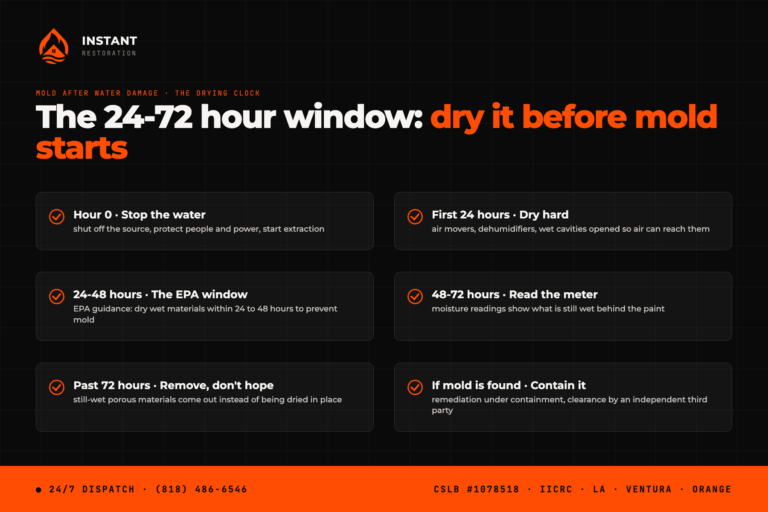
The report becomes the remediation scope. On a remediation job, the moisture source gets fixed first, or the growth comes back. Then containment goes up so nothing disturbed travels to the rest of the house, negative air keeps the dust inside it, and the materials that can’t be cleaned come out. What stays gets cleaned and dried until it reads dry on a moisture meter. We work to the IICRC S520 standard for mold remediation.
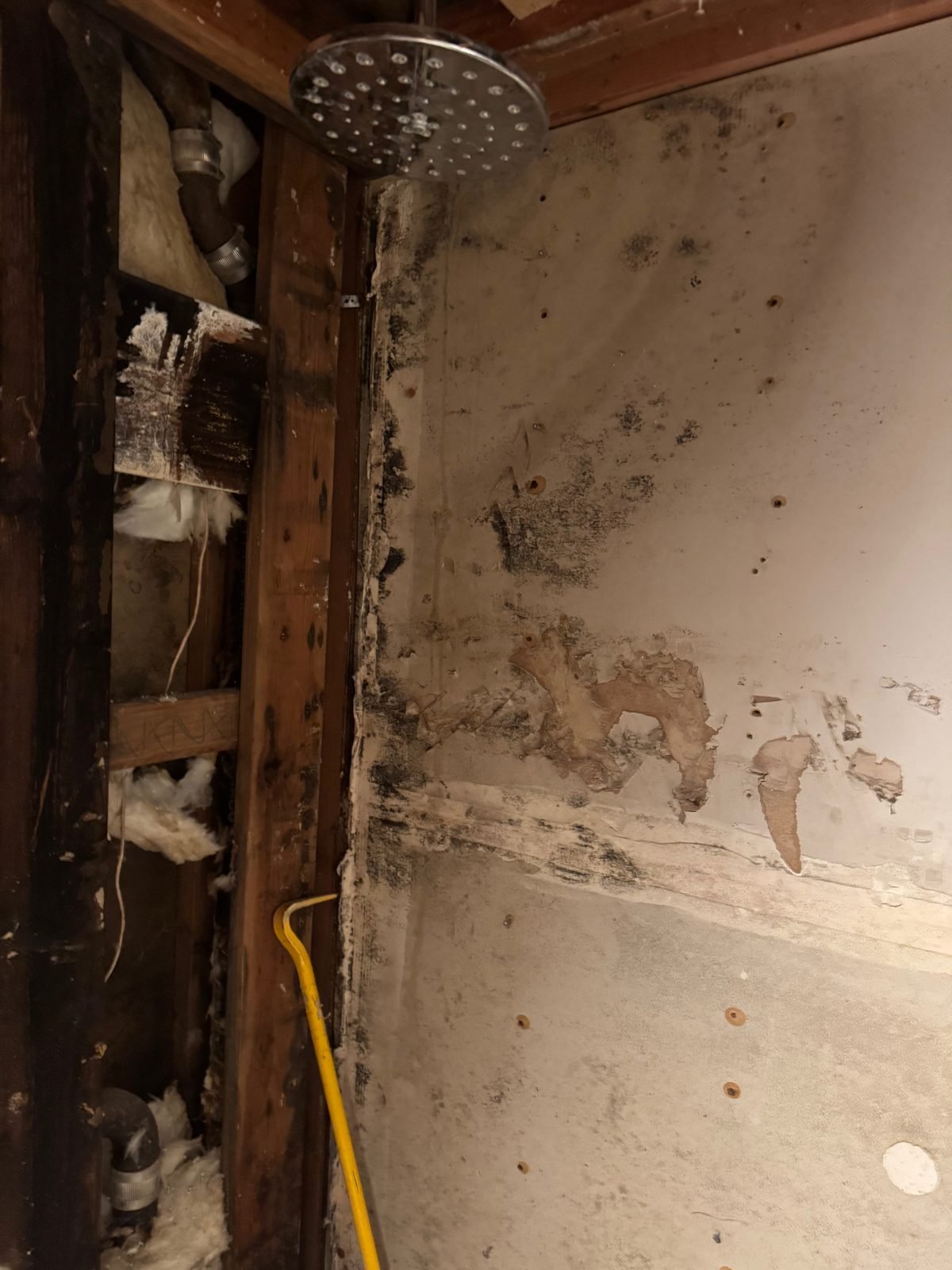
Woodland Hills: mold on the wall board beside a shower, with the framing next to it opened up. Growth inside and behind a wall like this is what careful moisture readings are meant to find.
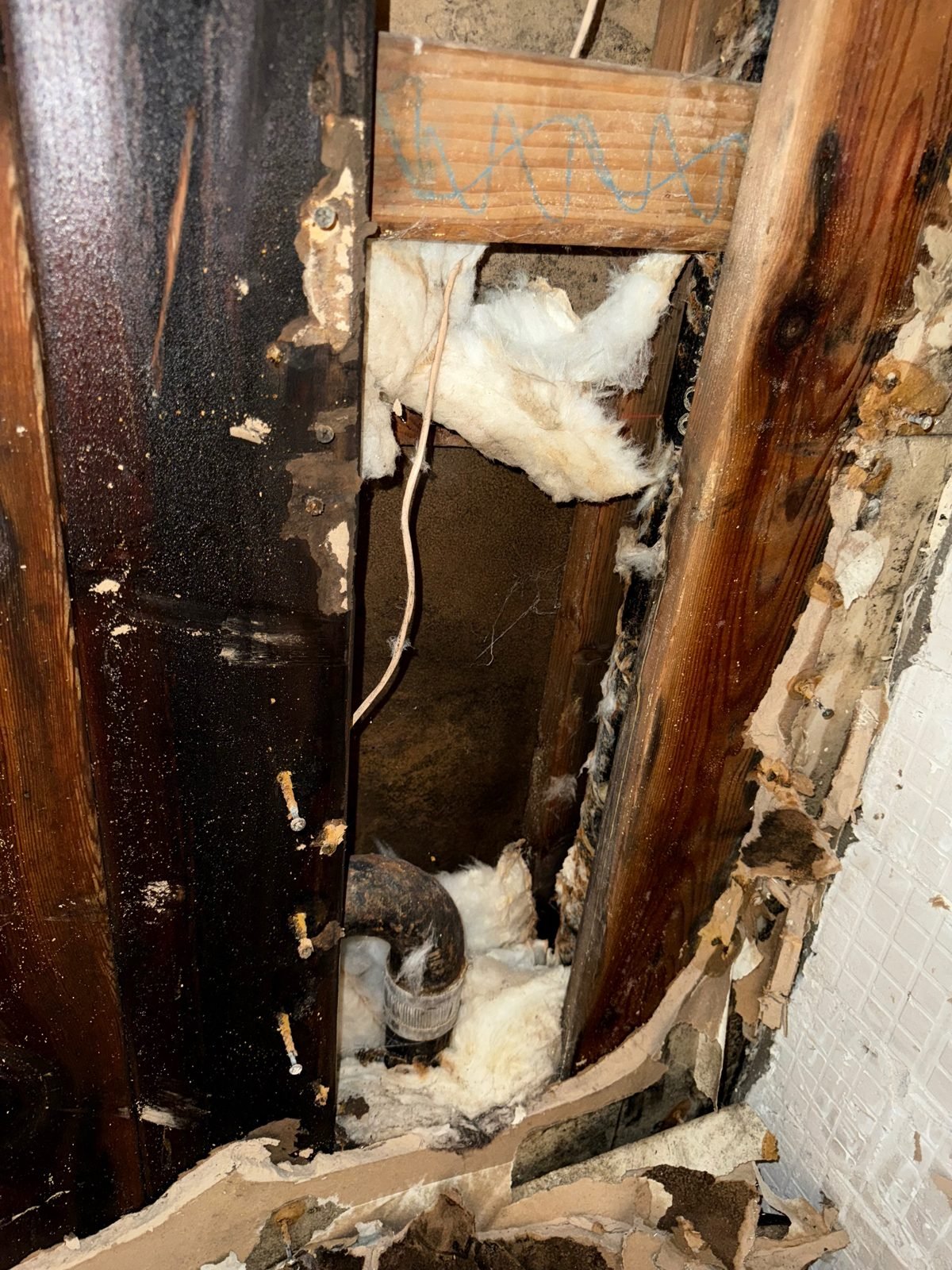
The same Woodland Hills job: an opened wall cavity with dark-stained studs, insulation and a drain pipe.
Before anything gets closed up or rebuilt, the independent inspector comes back for clearance: a visual check that the growth is gone, and often air samples compared with outdoors again. If something’s missed, it gets fixed while the walls are still open. If the mold followed a leak, see how fast mold grows after water damage and our water damage restoration page. For costs by job size, see our mold remediation cost guide.
If anyone in the house has symptoms you think are tied to mold, take the inspection report to a doctor. We are restoration professionals, not medical professionals, and we won’t tell you whether a result is safe for your family.
Got an inspection report and need the work done? Call (818) 486-6546. We answer 24/7, and scheduled on-site assessments run Monday to Saturday, 9 AM to 5 PM. You’ll get a written scope and price before work starts.
Oren Gedalia, Owner — IICRC-certified · CSLB #1078518