
A Red Flag Warning means the weather has lined up for fast-spreading fire. The National Weather Service issues one when fire conditions are happening now or expected shortly, which in Southern California usually means strong, dry wind over dry brush. It isn’t an evacuation order, and it doesn’t mean there’s a fire near you. It means a spark that would normally fizzle out could take off. Use it as your cue to get the house and the car ready, stop anything that throws sparks, and know how you’d leave if you had to.
What’s the difference between a Fire Weather Watch and a Red Flag Warning?
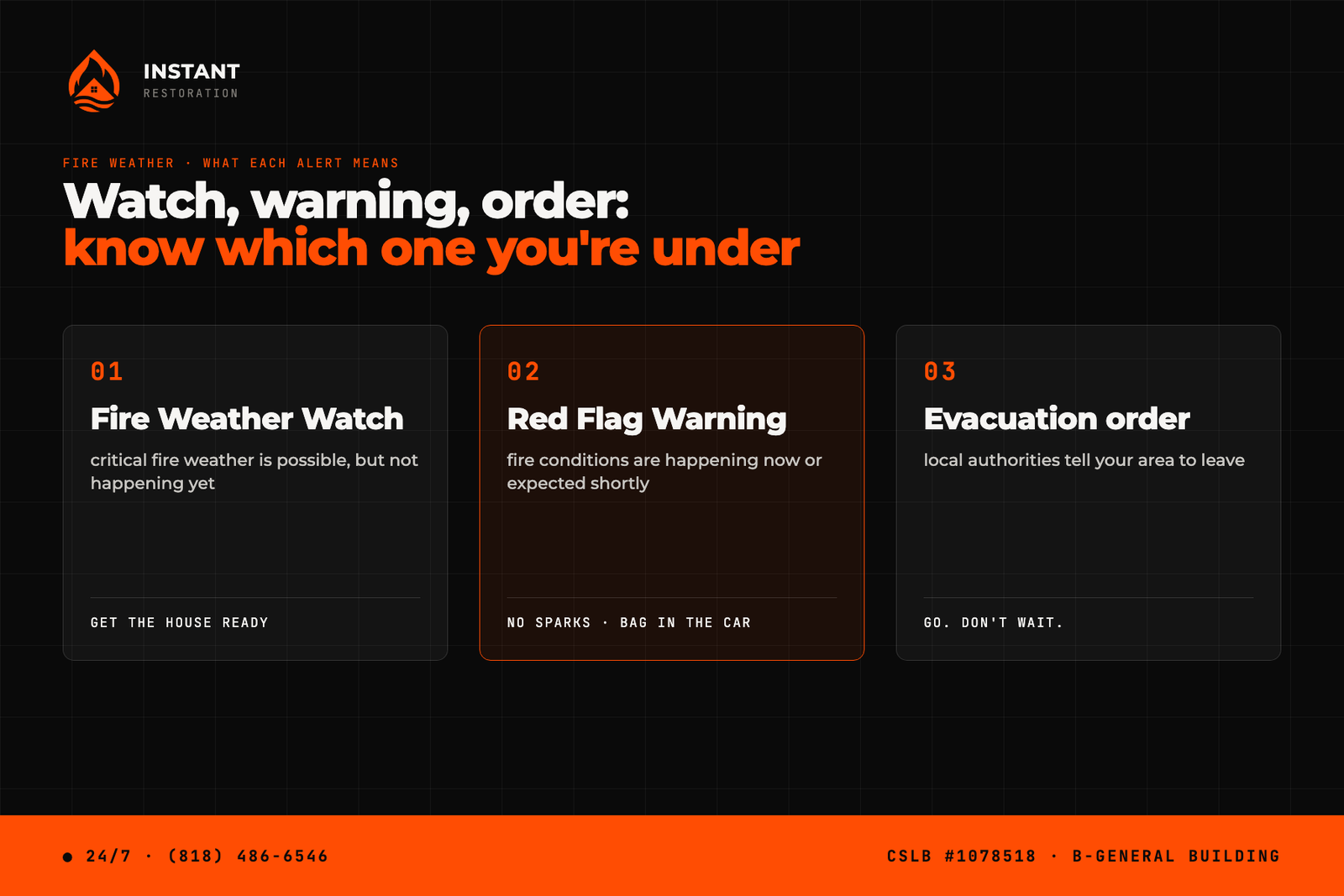
They’re two steps on the same ladder, and the National Weather Service’s wildfire watch and warning page spells it out. A Fire Weather Watch means critical fire weather conditions are possible but not imminent or occurring. A Red Flag Warning means fire conditions are ongoing or expected to occur shortly.
Put simply:
- Fire Weather Watch: the forecast says it might get dangerous. Get the house ready while it’s calm.
- Red Flag Warning: it’s dangerous now, or about to be. Finish the prep, stop anything that sparks, and keep your bag in the car.
- Evacuation warning or order: that comes from local authorities, not the weather service, and it’s about a real fire. If they tell you to go, go.
In LA and Ventura County, fall and early winter are when Santa Ana winds push the driest air of the year down the canyons. Our Santa Ana winds and fire season guide explains why that stretch is the riskiest part of the year here, even after the first rain.
Does a Red Flag Warning mean I should evacuate?
No, not on its own. A Red Flag Warning is about weather. An evacuation order is about a fire, and it comes from your county, city, sheriff or fire department. Follow what they tell you, and if they say leave, leave right away.
What a warning does mean is that if a fire starts, it can move faster than you’d expect, and there may not be much time between the first alert and the order. That’s why the warning is the moment to get ready to leave, so you aren’t packing while the road fills up:
- Put a go bag in the car: medications, phone chargers, glasses, important papers, a change of clothes, water and a first aid kit.
- Park facing out, with a full tank or a full charge.
- Know two ways out of your neighborhood, because one road can close.
- Keep pets where you can grab them, with carriers and leashes by the door.
- Sign up for your county’s emergency alerts and keep your phone charged.
Ready.gov’s wildfire page covers the same basics: have a go bag in the car, learn your evacuation routes, and evacuate immediately if authorities tell you to.
How do you protect your home when a Red Flag Warning is issued?
Most of the work is outside, and most of it is about what’s touching or close to the house. Wind-driven embers can land well ahead of a fire, and they find dry leaves, gutters, wood piles and doormats. Work from the house outward:
- Clear the first 30 feet. Ready.gov recommends a fire-resistant zone free of leaves, debris or flammable materials for at least 30 feet from your home. Rake leaves and pine needles away from walls, decks and fences.
- Clean the roof and gutters. Dry leaves in a gutter are the first thing an ember lands in.
- Move what burns away from the walls: patio cushions, wood piles, trash bins, propane tanks, brooms and doormats. Bring cushions inside or put them in the garage.
- Close up the house. Shut windows, doors and the garage door. If your HVAC pulls in outside air, set it to recirculate and close the outdoor intake.
- Get a hose ready that reaches every side of the property.
Don’t climb on the roof in high wind. If the gutters didn’t get done before the wind picked up, skip it. A fall won’t wait for the fire.
What should you do before fire season even starts?
The warning is the wrong time to start a project. The useful work happens on calm weeks:
- Take a video of every room, opening closets and drawers, and save it somewhere that isn’t the house. If you ever file a claim, that record matters. We document the loss; the adjuster decides what’s covered.
- Know where your important papers are, or scan them.
- Keep a high-efficiency HVAC filter on hand, so you can swap it after a smoke event without a store run.
- Pick a room you can close off from outside air, with a portable HEPA air cleaner in it, for smoky days.
- Talk through the plan with everyone in the house, including where you’ll meet if you get split up.
Your utility may also shut off power to high-risk areas during dangerous fire weather. Keep a flashlight, a battery bank and a way to open the garage door by hand.
What should you check after a Red Flag Warning ends?
Even when no fire comes close, high wind on a fire weather day can carry smoke and ash a long way, and the house may have pulled some of it inside. Before you start cleaning, walk the house:
- Look at the HVAC filter. If it’s gray, change it.
- Check attic and foundation vents for ash, and look in the attic if you can get up there safely.
- Look at window sills, sliding door tracks and light-colored walls for a gray film.
- Notice the smell. A smoky smell that comes back on warm days means residue is still somewhere in the house.
If there’s ash and soot inside, the order you clean in matters. Clean the air first, then hard surfaces dry before wet, then fabrics and the HVAC system. Our guide to cleaning wildfire smoke out of your house walks through each step.
When does a home need professional smoke or fire damage work?
A little ash on the patio furniture is a hose-and-rag job. Call a pro when:
- Soot film shows up on walls and ceilings in more than one room
- There’s ash in the attic, the crawlspace or the ducts
- The smoke smell keeps coming back after you’ve cleaned and aired the house out
- Any part of the home took heat or flame, even a fence, an eave or a vent cover
Professional smoke damage restoration works to the IICRC S700 standard: protect what’s clean, HEPA-clean the air and surfaces, remove what can’t be saved, clean the HVAC system, then treat the odor at its source. If there was flame damage, our fire damage restoration page covers that work, and our fire damage restoration process post walks through it from board-up to rebuild. If asbestos is suspected in an older home, we stop and bring in a licensed abatement firm before anything gets cut.
Smoke or ash got into your home after a fire weather event? Call (818) 486-6546. We answer 24/7, and scheduled on-site assessments run Monday to Saturday, 9 AM to 5 PM. You’ll get a written scope and price before work starts.
Oren Gedalia, Owner — IICRC-certified · CSLB #1078518