
The first real storm of the season does more damage in LA than bigger storms later in the winter — because it hits homes that have had six dry months to develop clogged gutters, brittle branches, and forgotten drains, and homeowners who haven’t thought about rain since spring. If you want to prepare your home for storm season in Los Angeles, the work fits in one weekend, costs almost nothing, and every item below is something we’ve seen skipped by a family who later called us with water inside the house. This is a living checklist — we update it as the season develops, so bookmark it and run it before the first named system rolls in. With a very strong El Niño forecast for this winter (details in our El Niño guide), this year the first storm may not be a gentle warm-up.
Why does the first storm cause so much damage?
Three reasons, all fixable in advance. First, debris: half a year of leaves, jacaranda drop, and roof grit is sitting in gutters and drains right now, and the first rain moves all of it at once. Second, deferred wear: the sun cooks roofing all summer — lifted shingles, cracked mastic around vents, dried-out flashing — and the first wind-driven rain finds every gap. Third, rust: not the metal kind, the human kind. Shutoff valves nobody has touched in years, sump pumps that haven’t cycled since March, alert apps nobody installed. The checklist below works through all three.
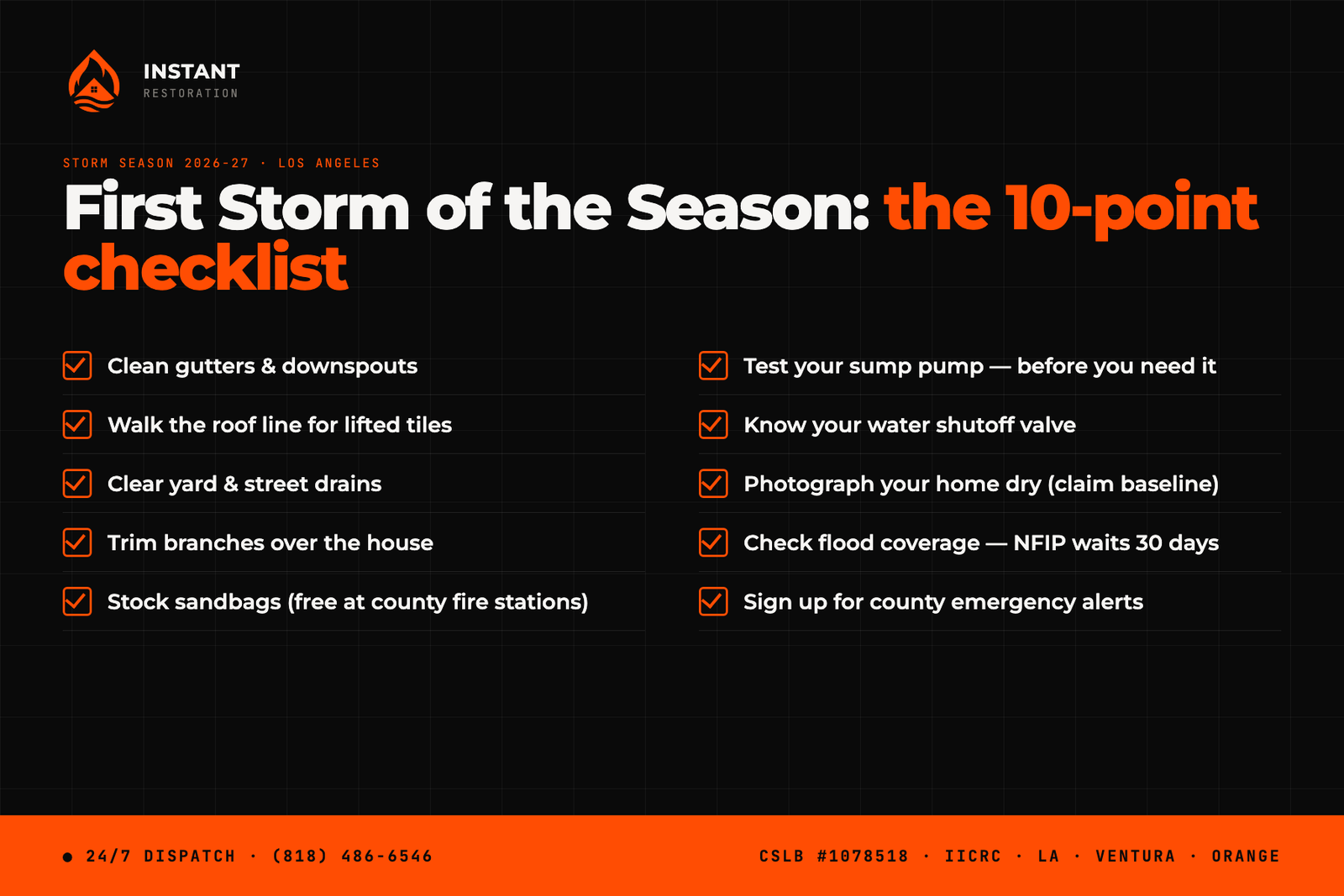
The 10-point checklist, explained
- Clean gutters and downspouts. Full gutters don’t just overflow — they push water under the roof edge and down inside walls. Flush downspouts with a hose until water runs clear at the bottom, and make sure they discharge away from the foundation.
- Walk your roof line — from the ground. Binoculars beat ladders. You’re looking for lifted or slipped tiles and shingles, and cracked seals around vents and skylights. One displaced tile is a drip inside a wall by the third storm.
- Clear yard and street drains. The little grate at the low point of your yard and the curb drain in front of your house are your property’s exit routes. Two minutes with a gloved hand now beats a flooded garage at midnight.
- Trim what hangs over the house. Summer-stressed limbs snap in the first wind. Anything dead, cracked, or resting on the roof goes now — tree crews are cheap in October and booked solid in January.
- Stock sandbags early. LA County fire stations hand them out free. Get them on a sunny weekend; the week a storm is named, stations run empty. If you’re below a recent burn scar, this item is not optional — our burn-scar flood prep guide covers that special case.
- Test the sump pump. If you have one, pour a bucket of water into the pit and watch it cycle. If it hums, rattles, or does nothing, you just found out in October instead of during the storm.
- Find your water shutoff valve. Storm damage and plumbing failures travel together — saturated ground shifts pipes, roof leaks find electrical, and panicked minutes matter. Everyone in the house should know where the main shutoff is and how it turns.
- Photograph your home dry. Walk every room and the exterior with your phone. If you ever file a claim this winter, the before pictures are the difference between “prove it was the storm” and a clean payout. Five minutes, enormous leverage.
- Check your flood coverage now. Standard homeowners policies exclude flood — that’s a separate NFIP policy, and it typically takes 30 days to go into effect. Deciding you want it after the forecast turns is exactly 30 days too late.
- Sign up for alerts. Ready LA County for emergency notifications, and the National Weather Service Los Angeles for watches and warnings. A Flash Flood Warning that reaches your phone ten minutes early is worth more than every sandbag on this list.
What should you do when the first storm actually hits?
Stay off the roof and out of standing water, and let the house do its job. If water does get in: kill power to the affected area if you can do it safely, move what’s movable, photograph everything before you touch it, and start extraction fast — our first-24-hours guide walks through the sequence hour by hour. The difference between a dry-out and a rebuild is usually measured in hours, not days.
Living checklist — what we’ll update
This post is pinned for the season. As storms develop, we’ll update it with what we’re seeing on real calls across Los Angeles County, Ventura, and Orange — the failure points that are actually flooding homes that week, and any changes to county sandbag distribution or alert systems. Check back before each major system.
If the first storm wins anyway — water inside, mud in the garage, a ceiling stain spreading — call (818) 486-6546. We run water damage restoration 24/7 across all three counties, and the earlier we start, the less of your home the storm gets to keep.
Oren Gedalia, Owner — CSLB #1078518