


The cheapest water damage is the leak you find while it’s still a drip. A good water damage prevention checklist doesn’t need a plumber or special tools. It needs one morning a month, a flashlight, and a fixed route through the house: read the water meter, open every sink cabinet, test the toilets, look hard at the water heater, check the appliance hoses, then step outside to the AC drain line, the sprinklers, and the gutters. Most of the slow-leak damage we end up tearing out, the swollen cabinet floor, the stain on the ceiling under a bathroom, the soft wall behind a washer, gave off signs for weeks before anyone saw them. This check is how you see them first.
Why does a monthly water damage prevention checklist beat waiting for a problem?
Because the leaks that do the most damage are quiet. A burst pipe gets noticed in seconds. A weeping supply line under a sink or a hairline crack in a toilet tank can run for weeks, and the water goes where you can’t see it: into the cabinet floor, the subfloor, the wall cavity. The EPA’s WaterSense program estimates that household leaks nationwide waste about 1 trillion gallons of water annually. That’s the water bill side of it. The building side is worse.
The EPA’s mold and moisture guidance is to dry water-damaged materials within 24 to 48 hours — materials dried in that window will, in most cases, not grow mold. A slow leak never gives materials that chance. They stay damp for weeks, which is exactly the condition mold needs. A monthly check means a hidden leak runs for weeks at most instead of months, and that’s often the difference between a plumbing repair and a remediation job.
How do you use your water meter to find hidden leaks?
This is the single most useful test in the checklist, because it catches leaks you can’t see at all, including ones under a slab or inside a wall. Turn off every fixture and water-using appliance in the house, and make sure irrigation isn’t scheduled to run. Find your meter, usually in a box near the curb, and look for the small leak indicator on its face, often a triangle or small dial. If it’s turning while nothing in the house is using water, water is escaping somewhere.
For a slower leak, write down the full meter reading before bed and read it again first thing in the morning before anyone uses water. Any change is a leak. If the meter moves and you can’t find the source in the house, call a plumber for leak detection before you call anyone else.
What should you look for under the sinks?
Open every cabinet: kitchen, bathrooms, laundry, wet bar. With a flashlight, look at the cabinet floor for staining, swelling, or a warped surface. Run your hand along the supply lines and the connections at the shutoff valves and the faucet; a line that’s damp to the touch is leaking even if nothing is dripping. Check the P-trap and, in the kitchen, the bottom of the garbage disposal. Once a year, gently turn each shutoff valve closed and open again. A valve that’s frozen in place is useless in an emergency, and it’s much better to find that out on a quiet Saturday.
How can you tell if a toilet is leaking?
Two checks. First, the silent leak inside the tank: put a few drops of food coloring in the tank, don’t flush, and come back later in the morning. Color in the bowl means the flapper is leaking. That one wastes water but rarely damages the house. Second, the one that does damage: look at the base. A toilet that rocks, a floor that feels soft around it, discoloration in the flooring, or a stain on the ceiling below an upstairs bathroom all point to a failed wax seal or a leak at the supply line. Those leaks go straight into the subfloor.
What are the warning signs on a water heater?
Water heaters fail in two ways: slowly and all at once. The monthly look catches the slow version before it becomes the fast one. Check for water in the drain pan or on the floor around the base, drips from the relief valve’s discharge pipe, rust or corrosion at the fittings on top or around the bottom of the tank, and new rumbling or popping sounds. Look at the manufacture date on the label, because tanks give warning signs as they near the end of their life. While you’re there, make sure the seismic straps are tight. A tank failure in a garage is a mess; one in an interior closet or an attic is a ceiling, a wall, and a floor.
Which appliance hoses fail most often?
The washing machine supply hoses are the classic failure. They sit under constant pressure, and when a rubber hose lets go it doesn’t drip, it floods. Pull the machine out enough to see the hoses and look for bulges, cracks, or rust at the fittings. If yours are plain rubber, braided stainless replacements are an inexpensive upgrade; write the install date on them with a marker. Then check the refrigerator ice maker line, often thin plastic tubing that cracks with age, and the dishwasher: pull the kick plate and look underneath with a flashlight for water or staining. Check the flooring edges around all three.
What should you check outside and at the AC?
Air conditioners make water. The condensate drain line carries it away, and when that line clogs, the overflow goes into the drain pan, then the ceiling or the wall, especially with an attic unit. Make sure the line is flowing at its outlet while the AC runs, and that the pan is dry. Outside, watch one full sprinkler cycle: heads spraying the stucco or pooling water against the foundation push moisture into the walls. Check hose bibs for drips, and make sure the ground slopes away from the house. Gutters and downspouts belong on the list too, and they become urgent before the rainy season; our first storm of the season checklist covers the storm-prep side.
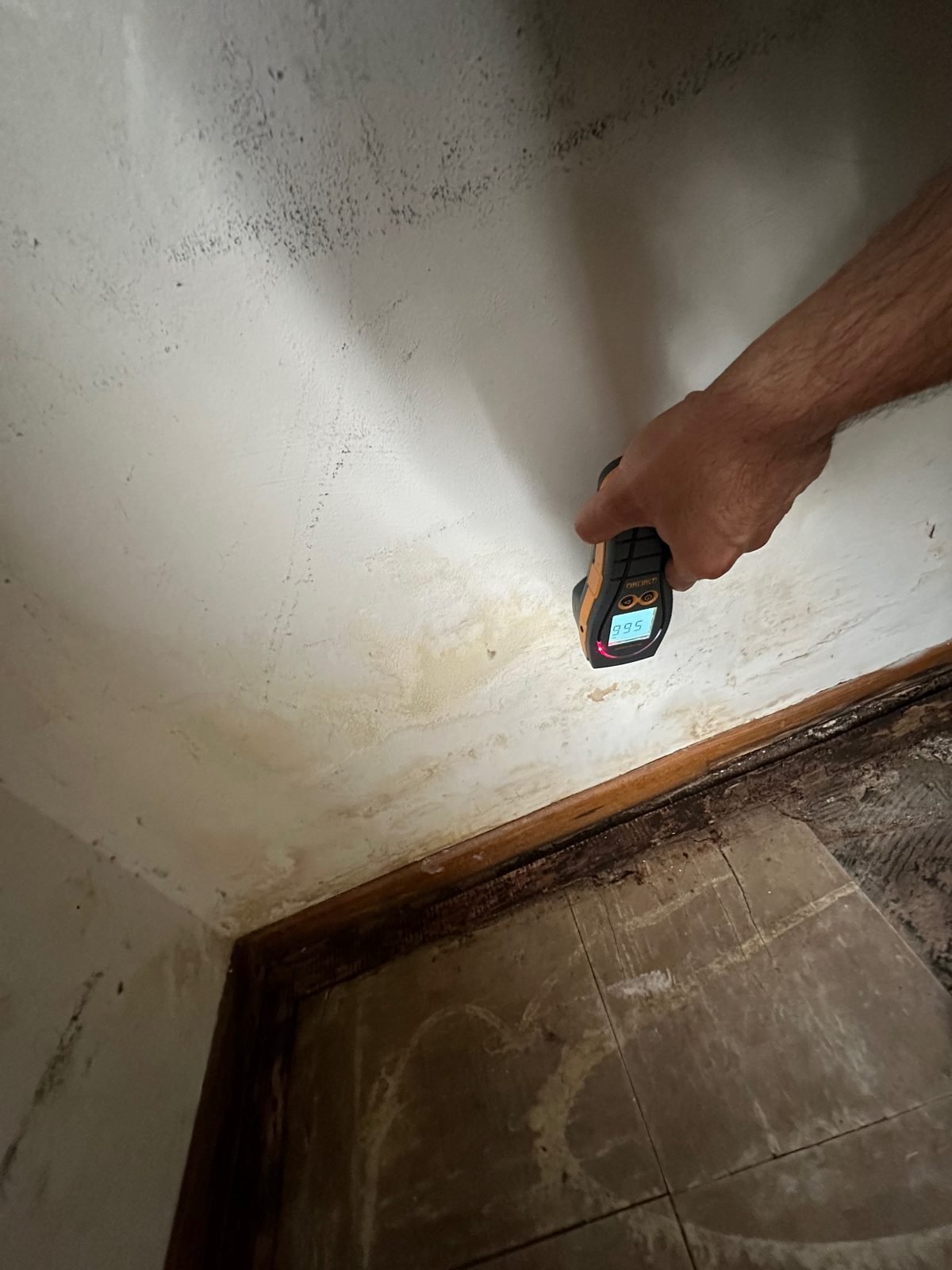
What a missed leak becomes: on this Los Angeles job the meter pinned at 99.5 on a wall that looked merely dusty — the subfloor below it had already rotted. The monthly check exists so you find this at week one, not month six.
What should you do if the check finds a leak?
Stop the water first, at the fixture shutoff or, if needed, at the main. Know where your main shutoff is before you need it. Photograph what you found before you dry anything, then dry what you can reach and call a plumber for the repair.
The question after that is where the water went. If drywall, cabinet floors, or subfloor have been wet for more than a day or two, or you notice a musty smell, the damage is likely bigger than what you can see. That’s where our water damage restoration crews come in: moisture mapping to find exactly how far the water traveled, targeted removal of what can’t be dried, and structural drying with readings to prove it. If mold has already started, that becomes mold remediation under containment, with clearance confirmed by an independent third party. Our first 24 hours after water damage guide walks through the bigger-leak scenario, and our crews are based in Woodland Hills, serving homes across LA, Ventura, and Orange County.
Found a leak and not sure how far the water went? Call (818) 486-6546. We answer 24/7, and we’ll show you with moisture readings exactly what’s wet and what isn’t.
Oren Gedalia, Owner — CSLB #1078518