

Here’s the pattern behind almost every ceiling stain we get called to in November: the roof didn’t fail in the storm — it failed in July, silently, and the storm just delivered the news. To prepare a roof for rain in Southern California you have to think about what six months of sun, heat, and neglect did while it wasn’t raining: shingles curled, mastic cracked, gutters filled, and nobody looked, because why would you look at a roof in a drought? Then the first real storm arrives — often an atmospheric river that rains for 24 hours straight — and finds every one of those flaws at once. This guide covers the six places LA roofs actually fail, the 20-minute ground-level inspection that catches most of them, and what to do in the ugly moment a stain blooms across your ceiling mid-storm.
Why does the FIRST storm do the damage?
Three reasons. First, summer is hard on roofs here: months of UV and 100-degree attic temperatures dry out shingles, sealants, and flashing cement, and nothing reveals it until water arrives. Second, the first storms of the season are often the long, soaking kind — sustained rain finds slow paths through a roof that a 20-minute shower never would (our atmospheric river guide explains why duration, not intensity, is the local hazard). Third, everything upstream is at its worst: gutters carry a full summer of debris, so even a sound roof can flood at its own edges when the water has nowhere to drain.
The six failure points, in the order we find them
- Lifted, curled, or slipped shingles and tiles. Heat curls composition shingles at the edges; wind lifts them; a slipped clay tile leaves a direct path to the underlayment. One displaced unit is a drip; the drip is inside a wall by storm three.
- Cracked seals at vents, pipes, and skylights. The rubber boots and mastic around roof penetrations are the single most common leak source we trace. They dry, shrink, and split — invisible from the ground, obvious to a hose test.
- Full gutters and downspouts. Overflowing gutters don’t just spill — they back water up under the roof edge and send it down inside the wall cavity, which is why “roof leak” calls sometimes end at a clean roof and a packed gutter.
- Ponding on flat roofs. LA’s flat and low-slope roofs hold water after rain; a day-two storm lands on a roof already loaded, and seams that handle rain fail under standing water.
- Flashing at walls, chimneys, and valleys. Hairline separations where roof meets vertical surfaces leak only in long storms — the exact kind this winter is forecast to bring.
- Debris on the roof itself. Leaf mats and palm debris dam water and steer it sideways under the shingle line. Clearing the roof field matters as much as the gutters.
The 20-minute inspection you can do from the ground
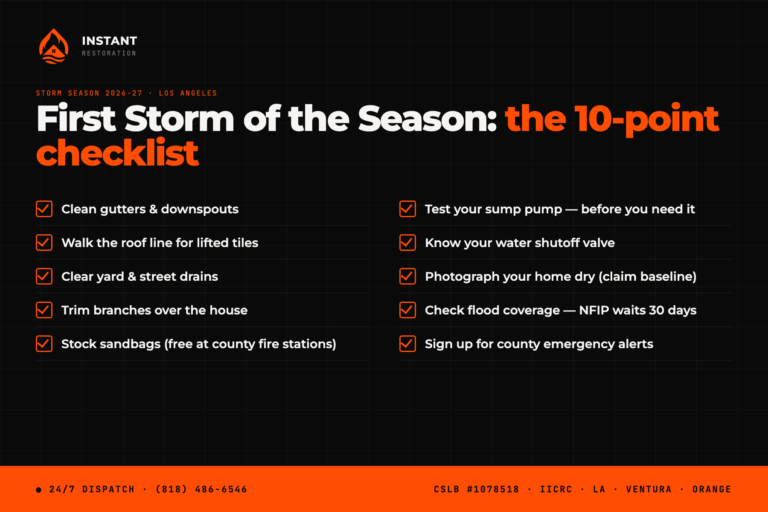
Binoculars beat ladders — nobody should be on a roof for this. Walk the house perimeter and look for: shingle edges that curl or shadows that show lifting; tiles out of line; anything shiny or cracked around vents and skylights; gutters with plants growing in them (the honest tell); dark streaks below flashing lines; and debris mats on the field. Inside, visit the attic with a flashlight on a sunny day — pinholes of daylight and water-stained sheathing are last winter’s leaks announcing this winter’s. Ten minutes outside, ten in the attic, and you’ve found what the first storm would have found for you. Fold it into the same weekend as our first-storm checklist — items one and two are this job.
What if a ceiling stain appears mid-storm?
Don’t wait for the storm to end. Put a container under any active drip, move what’s movable, and if the ceiling is bulging, poke a small relief hole at the low point into a bucket — a controlled quart through a pencil hole beats an uncontrolled ceiling collapse. Photograph everything for the claim (wind and rain damage to a roof, and the interior water damage that follows, are generally covered perils on homeowners policies — document first, dry second). Then get drying started fast: a one-storm leak caught in 48 hours is usually a dry-out and a patch; the same leak ignored through a storm series becomes saturated insulation, stained drywall, and a mold timeline. That emergency response — extraction, drying, moisture verification, and the rebuild after — is exactly our water damage restoration work, and during storm weeks across LA County it’s most of what we do. The NWS Los Angeles forecast tells you when the test is coming; the checklist above decides whether your roof passes it.
Water already inside? Ceiling down, insulation soaked, that smell starting? Call (818) 486-6546 — 24/7, and during storm runs we surge crews for exactly this.
Oren Gedalia, Owner — CSLB #1078518