
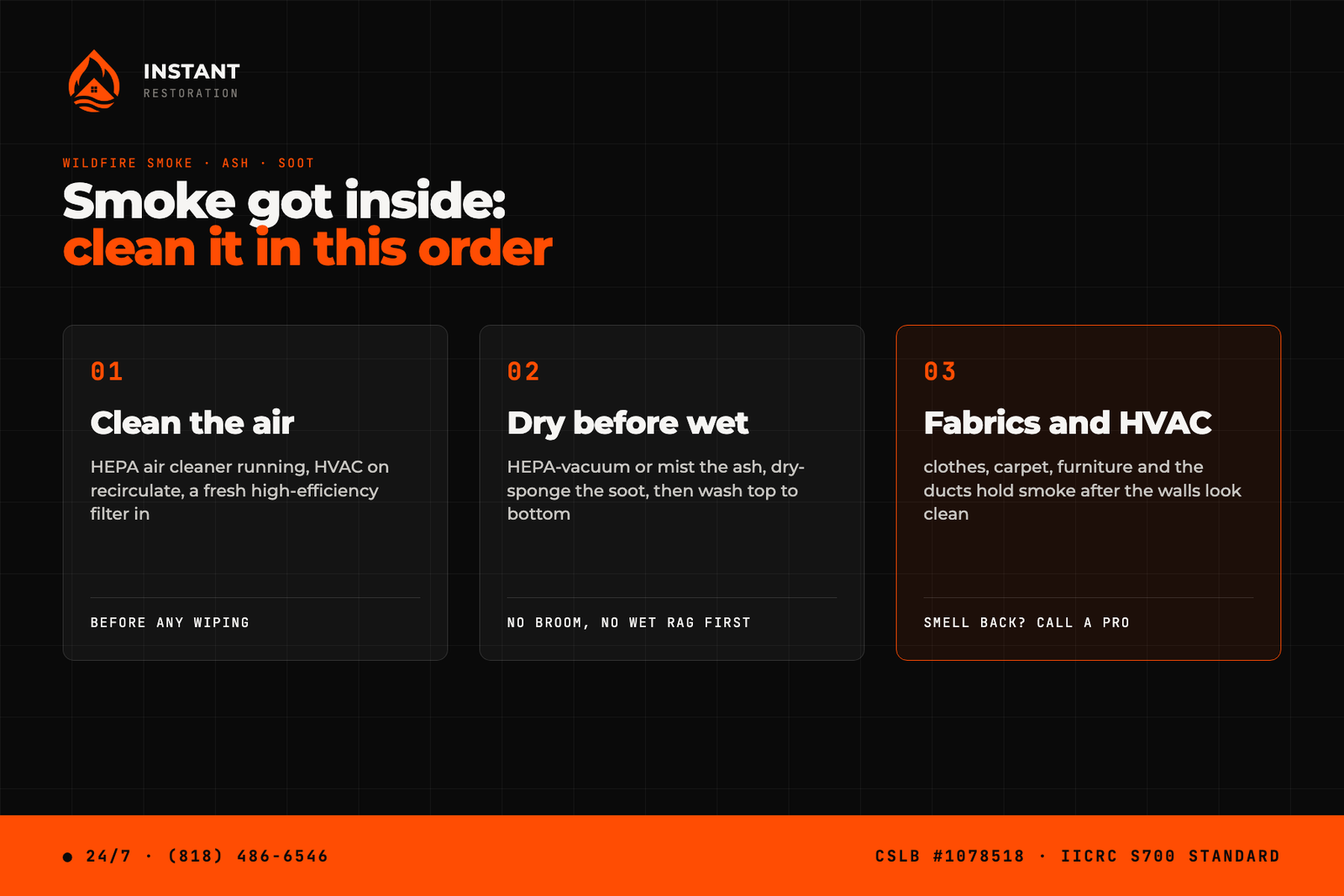
Wildfire smoke gets inside even when the fire never comes close. It comes through gaps around doors and windows, attic and foundation vents, and the HVAC system, and it leaves fine soot, ash and odor on everything it touches. The order matters more than the products: clean the air first, then hard surfaces dry before wet, then fabrics and the HVAC system. If the smell keeps coming back, residue reappears after you’ve cleaned it, or there’s ash inside the ducts, it’s bigger than a weekend job. Here’s how to tell which one you’ve got.
How does wildfire smoke get inside a closed house?
Smoke isn’t one thing. It’s a mix of gases and fine particles, and the particles are small enough to ride air leaks you’d never notice. The EPA’s guide to wildfires and indoor air quality explains how those fine particles get indoors and what you can do to reduce them. A shut window helps. It doesn’t seal the house.
The usual ways in are the ones the house uses to breathe:
- Door and window gaps, especially older weatherstripping and sliding doors
- Attic and foundation vents, which carry ash into the attic and crawlspace, out of sight
- The HVAC system, if it’s pulling in outdoor air or the ducts leak in the attic
- Fireplaces, dryer vents and kitchen hoods, wherever there’s a straight path outside
That’s why a house miles from the fire line can still smell like a campfire after a big Santa Ana event. Our Santa Ana winds and fire season guide covers why LA’s smoke days stack up in fall.
Should you clean the air before you clean anything else?
Yes. If smoke is still moving through the house, every surface you clean picks up a fresh layer. Check outdoor conditions on AirNow’s wildfire page, which reports the Air Quality Index and smoke maps, and start inside once the smoke has passed.
Then get the air moving through a filter instead of around the room:
- Run a portable air cleaner with a HEPA filter in the room you’re working in, and in the bedrooms at night.
- Set the HVAC to recirculate, so it isn’t pulling in outdoor air, and run the fan.
- Swap in a high-efficiency filter. The EPA guide recommends a MERV 13 filter or the highest rating your system can take. The old filter’s full of soot now; bag it and throw it out.
- Don’t add to it. Skip candles, frying and a regular vacuum until the air’s clean.
One thing not to do: don’t run an ozone generator in a home people or pets are living in. It doesn’t remove soot or ash, and ozone irritates lungs on its own. Odor work comes later, and it’s covered in our post on smoke odor removal.
How do you clean wildfire ash and soot off surfaces?
Protect yourself first: gloves, long sleeves, eye protection and a well-fitting respirator (an N95 or better). Ash and soot are fine and irritating, and cleaning stirs them up. Keep kids and pets out of the room while you work.
Then work top to bottom, and dry before wet:
- Don’t sweep or use a regular vacuum. A broom and a household vacuum throw the fine stuff back into the air. Use a vacuum with a true HEPA filter, or lightly mist ash and wipe it up.
- Dry-sponge soot before anything wet. A dry chemical sponge (a soot sponge) lifts soot off walls, ceilings and lampshades. A wet rag first smears it into the paint, and then it’s a repaint instead of a cleaning.
- Then wash with a mild detergent, rinse, and dry. Change the water often. Gray water just moves soot around.
- Start high. Ceilings, then walls, then furniture, then floors, so nothing you clean gets dusted again.
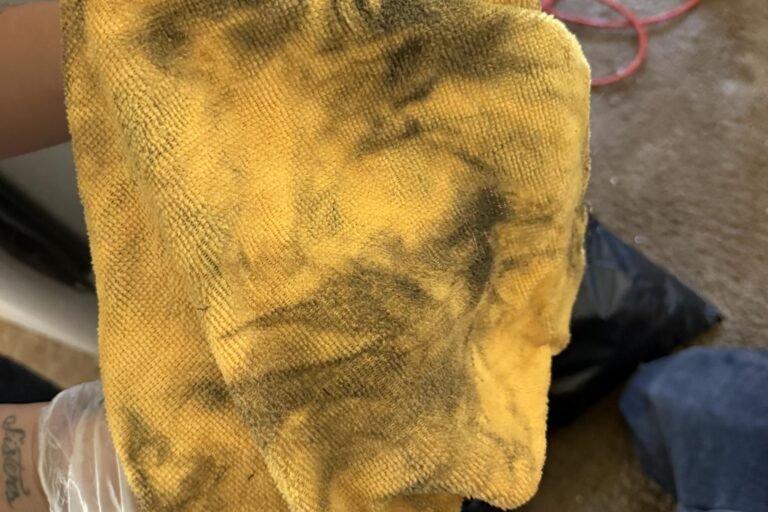
Window tracks, blinds, light fixtures and the tops of cabinets collect more than you’d think. If a light-colored wall shows a gray shadow behind picture frames, that’s soot film, and the whole wall’s carrying it.
What about clothes, furniture, carpet and the HVAC system?
This is where smoke hides. Walls can look clean while the house still smells, because soft materials soak up odor and fine particles the way a sponge soaks up water.
- Clothes and bedding: wash them, more than once if the smell survives. Shake them out outside, not in the house.
- Upholstered furniture and curtains: HEPA-vacuum first. Heavier smoke usually needs professional cleaning, and some pieces won’t come back.
- Carpet and pad: HEPA-vacuum, then a hot-water extraction clean. If the odor’s in the pad, the pad usually comes out.
- HVAC: after a heavy smoke event, ash in the return grilles or the ducts means the system’s spreading it every time it runs. That’s when duct cleaning belongs on the list, not before.
Keep a list as you go, with photos of anything you throw out. If you’re filing a smoke claim, your insurer will want that record. We document the loss; the adjuster decides what’s covered.
Is the air in my house safe after a wildfire?
We are restoration professionals, not medical professionals. If anyone in the home has asthma, a heart or lung condition, is pregnant, very young or older, ask their doctor before they move back into a smoky house, and call a doctor if anyone has trouble breathing.
What we can tell you is what we look for. Smoke odor that comes back on warm days, a gray film that reappears on surfaces you already cleaned, and soot in the HVAC returns all mean there’s still residue somewhere in the house. We’re a restoration contractor, not a testing lab. If you want lab numbers on what’s in your home’s air or on its surfaces, that’s work for an independent industrial hygienist, and their report is worth having before you decide how far the cleaning has to go.
When should you call a professional for smoke damage?
A light haze of ash on a patio table is a do-it-yourself job. Call a pro when:
- The smell comes back after you’ve cleaned, aired out and washed everything you can wash
- Soot film shows up on walls and ceilings across more than one room
- There’s ash in the attic, the crawlspace or the ducts
- Wet cleaning left streaks or a gray shadow that won’t come off
- The home took direct heat, melted plastics, or has any fire damage at all, not just smoke
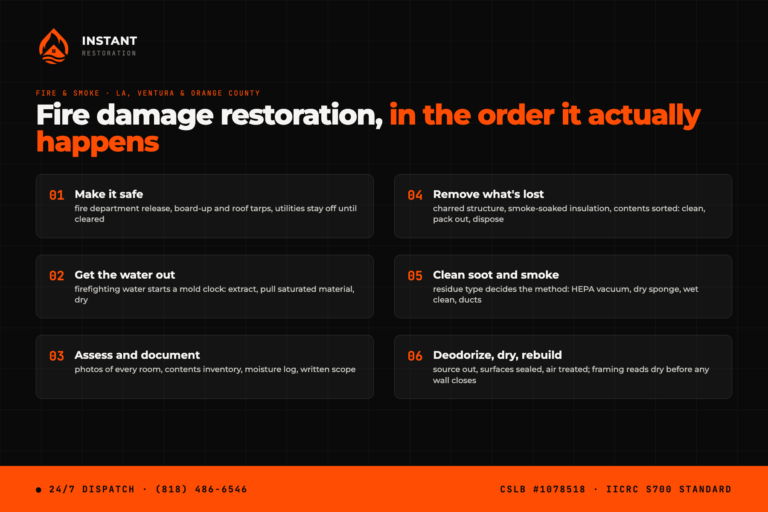
Professional smoke damage restoration works to the IICRC S700 standard and runs in a set order: protect what’s clean, HEPA-clean the air and surfaces, remove what can’t be saved, clean the HVAC system, then treat the odor at its source instead of covering it. If there was flame damage too, our fire damage restoration page covers that work, and our post on smoke damage vs. fire damage explains why an “undamaged” house can still need it.
Smoke got into your home? Call (818) 486-6546. We answer 24/7, and scheduled on-site assessments run Monday to Saturday, 9 AM to 5 PM. You’ll get a written scope and price before work starts.
Oren Gedalia, Owner — IICRC-certified · CSLB #1078518