Select the service that best matches your situation.
How would you like to connect?
Choose your preferred appointment type.
Pick a date & time
Available Monday–Saturday, 9 AM–5 PM.
Where can we reach you?
We’ll confirm your booking within the hour.
Emergency dispatch — we’ll call you within minutes of receiving this.
Thanks — we’ve got it.
We’ll call you within the hour at the number you provided. If this is an emergency, call us directly at (818) 486-6546.
Something went wrong.
We couldn’t send your request. Please call us at (818) 486-6546 — we’re standing by 24/7.
West Hills, CA · Fire Damage · IICRC S700
Fire Damage Restoration in West Hills, CA
Fire damage in West Hills runs three patterns: kitchen and electrical fires in 1960s–80s single-family tracts (the most common single-property loss), wildfire-zone exposure on the northern hillside properties bordering the Santa Susana foothills where homes sit in the Very High Fire Hazard Severity Zone, and commercial fires along Roscoe Boulevard and Vanowen Street. Each scope is different — but the IICRC S700 protocol and our CSLB #1078518 B-General rebuild license cover all of them. We handle structural fire damage mitigation through full rebuild on one license. IICRC S500/S520/S700 standards. Est. 2021.
Smoke penetrates everywhere — walls, HVAC, attic insulation, fabric, drywall. Soot is acidic and continues etching surfaces until professionally cleaned. Smoke damage often outlasts the fire itself by months.
Water damage from extinguishment.
Whatever the fire department used to put the fire out is now soaking into your floors, walls, and basement. Water damage from firefighting creates secondary structural issues and mold risk within 24–48 hours.
We handle all three under one project — IICRC S500 for water damage from extinguishment, IICRC S520 for resulting mold risk, and IICRC standards for fire and smoke restoration throughout.
Fire damage patterns in West Hills:
Kitchen fires.
The most common single-property cause — range, oven, microwave, or dishwasher origin. Smoke and soot spread far beyond the room of origin via HVAC, water damage from suppression efforts compounds the loss, and contents like cabinets, appliances, and soft goods often need pack-out.
Electrical fires.
Aging wiring in 1960s–80s construction, with outlet, panel, or attic ignition points. Often discovered late, with concealed damage inside walls — investigation and repair are required before reconstruction.
Wildfire-zone exposure (northern hillside, Santa Susana corridor, VHFHSZ).
On the northernmost hillside properties bordering the Santa Susana foothills — in the Very High Fire Hazard Severity Zone — ember intrusion through vents, eaves, and attic, heat damage to siding, windows, and landscaping, and smoke and ash entering the interior via HVAC during active burns. The January 2025 Palisades Fire pushed heavy smoke across West Hills for days.
Appliance & structural fires.
Dryer lint accumulation, garage workshop tools, wood-burning fireplaces or chimneys, and ranch-home construction fires are recurring ignition sources across West Hills homes.
HVAC and chimney fires.
Older systems and deferred maintenance lead to HVAC- and chimney-origin fires that distribute soot throughout the home via ductwork.
Commercial fires.
Restaurant-kitchen and grease fires, retail electrical and contents fires, and office and light-industrial fires along Roscoe Boulevard and Vanowen Street — business interruption demands fast mitigation.
Section 03 · What it includes
Our IICRC S700 process.
A complete fire damage restoration project typically runs through these phases.
Emergency response
Board-up of broken windows, doors, and roof penetrations
Tarp damaged roofing
Secure the property against further loss
Assessment
Identify all smoke- and soot-affected areas — often far beyond the fire origin
Categorize soot type (wet smoke, dry smoke, protein, fuel oil)
Plan contents handling — in-place cleaning vs. pack-out
Document damage for the carrier
Mitigation
Soot removal — different methods per soot type
Surface cleaning of walls, ceilings, floors, and framing
Structural drying if there is water damage from suppression
Odor neutralization — ozone, thermal fogging, or hydroxyl
HVAC cleaning and decontamination
Contents
Pack-out to a controlled environment
Inventory and photograph everything
Clean what is salvageable
Document total-loss items for the carrier
Reconstruction
Demo affected materials
Frame, drywall, electrical, and plumbing as needed
Cabinetry, flooring, and paint
Final walkthrough and contents return
Our process in West Hills: 24/7 dispatch from Woodland Hills HQ, board-up and stabilization, assessment and carrier coordination, contents pack-out if needed, soot and smoke mitigation throughout the structure, structural drying if suppression water is present, odor neutralization, HVAC cleaning, reconstruction on our CSLB #1078518 B-General license, and contents return at the final walkthrough. Typical timeline: 1–2 weeks mitigation, 4–12 weeks reconstruction depending on scope.
Section 04 · One accountable team
One team, from the first board-up to the final walkthrough.
No second contractor, no scope handoff, no scheduling gap between mitigation and rebuild.
Insurance and process.
Fire claims are typically large and complex. We document for any carrier, and documentation is built into every job — photos, inventory, scope of work, and daily progress logs. What you do: call us 24/7, do not enter the property until a structural assessment confirms safety, and we coordinate board-up, mitigation, contents, and documentation for your carrier. Because we hold a CSLB #1078518 B-General Building license, we take the job from emergency board-up through final paint and contents return without subbing out the reconstruction.
Section 05 · Wildfire context
Wildfire context for West Hills.
West Hills borders the Santa Susana foothills and the Simi Hills corridor on its northern edge — the northernmost hillside properties sit in the Very High Fire Hazard Severity Zone, while the central Valley-flat tracts are not in a VHFHSZ.
West Hills borders the Santa Susana foothills and the Simi Hills corridor on its northern edge. Properties on the northernmost hillside areas fall in the Very High Fire Hazard Severity Zone (VHFHSZ) — the same fire-risk classification carried by Calabasas hillside areas. The central West Hills tracts in the Valley flats are not in VHFHSZ. The January 2025 Palisades Fire burned the Pacific Palisades, Malibu, Topanga, and Brentwood corridor — close enough that smoke and ash reached West Hills for days, and West Hills HVAC systems pulled smoke into homes during the active burn. The Palisades Fire did not directly burn West Hills. We respond to wildfire smoke damage and fire-zone restoration across the western Valley.
For the northern hillside properties in VHFHSZ, fire risk is ongoing — hardening considerations matter: ember-resistant vents, Class A roofing, defensible space. We do fire-zone restoration work and post-fire rebuild, not pre-fire hardening (that is a different scope). For the central Valley-flat tracts, the fire risk is overwhelmingly structural — kitchen, electrical, appliance, and commercial fires — plus the regional wildfire smoke that reaches the western Valley. We handle S700 mitigation through full rebuild on our B-General license.
Section 06 · Why West Hills calls us
Why West Hills homeowners call us for fire damage.
One local, licensed team from the emergency call through the rebuild.
The full IICRC S700 process.
Emergency board-up, soot categorization and removal, structural cleaning, odor neutralization, and HVAC decontamination — documented to the S700 standard adjusters require.
One license — mitigation through rebuild.
CSLB #1078518 B-General Building Contractor. We take the job from emergency board-up through final paint and contents return — no subbing out the reconstruction.
Contents pack-out and return.
We inventory and photograph everything, move salvageable items to controlled cleaning, document total-loss items for the carrier, and return restored contents at job completion.
Older homes: asbestos stops the job.
Fire damage can expose asbestos in older drywall, insulation, or pipe wrap on the 1960s–80s construction common in West Hills — if asbestos is suspected, we stop and bring in a licensed abatement firm before the work continues.
Wildfire-zone & commercial restoration scope.
The northern hillside properties bordering the Santa Susana foothills sit in the VHFHSZ — we do fire-zone restoration and post-fire rebuild, plus contents pack-out and HVAC decontamination after smoke exposure — and we work restaurant, retail, and light-industrial fires along Roscoe Boulevard and Vanowen Street.
Emergency board-up from Woodland Hills HQ.
We dispatch from our Woodland Hills headquarters, minutes east on Roscoe. Emergency board-up is available 24/7 — after-hours and weekends included.
Section 07 · Cost transparency
What fire restoration costs in West Hills.
Fire damage costs vary enormously by scope. Typical ranges, not quotes — every job is scoped in writing after a free assessment.
$15,000–50,000
Contained room fire — kitchen or single-appliance origin. Mitigation plus rebuild.
$50,000–150,000+
Multi-room smoke damage with structural fire.
$150,000–500,000+
Major structural fire with significant rebuild.
Commercial fire
Restaurant, retail, or light-industrial — scope-dependent, often $75,000–500,000+.
Total-loss rebuild
Full reconstruction cost on our B-General license.
Insurance documentation matters on fire claims. We document thoroughly to support your claim.
Section 08 · Recent work
What fire damage work looks like.
Real photos from our own jobs — and what a fire and smoke damage call in West Hills involves.
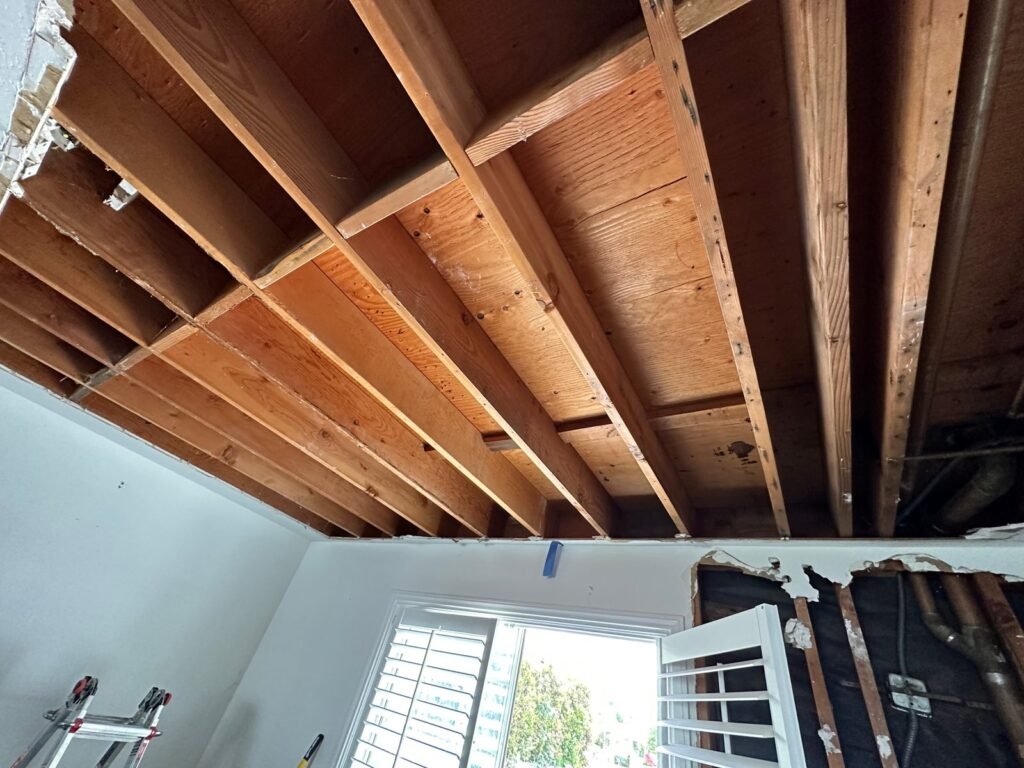
West Hills — fire damage restoration: what the work looks like.
The photo is from an Instant Restoration job (tear-out stage) in West Hills, Los Angeles County. On a typical fire and smoke damage call in West Hills the same licensed crew will secure the structure after the fire department clears it, remove debris and charred materials, clean soot and smoke residue from every surface, address odor at the source, document the loss for the insurance file, and rebuild with the same crew. We are a California-licensed general building contractor (CSLB #1078518), bonded and insured, and we answer 24/7.
Fire is three losses at once — flame, smoke, and water. We handle all three under one team.
Section 09 · Common questions
Frequently asked questions.
The questions we hear most about fire damage in West Hills. For the full process, see our fire damage restoration page.
How fast can you get to my West Hills fire damage?
Our response target is 55 minutes across Los Angeles, Ventura and Orange Counties. We dispatch from Woodland Hills HQ, minutes east on Roscoe. Emergency board-up is available 24/7 — after-hours and weekends included.
My home is on the northern hillside near the Santa Susana foothills — am I in the fire zone?
Properties on the northernmost hillside areas of West Hills, bordering the Santa Susana corridor, fall within the Very High Fire Hazard Severity Zone (VHFHSZ). The classification carries real implications for insurance, hardening requirements, and smoke exposure during regional fire events.
Did the Palisades Fire affect West Hills?
The January 2025 Palisades Fire burned the Pacific Palisades, Malibu, Topanga, and Brentwood corridor — it did not directly burn West Hills, but smoke and ash reached the city for days. HVAC systems pulled smoke into homes during the active burn. We respond to wildfire smoke damage and fire-zone restoration across the western Valley.
Can you do full rebuild after a fire?
Yes. CSLB #1078518 B-General Building covers full structural reconstruction. We take the job from emergency board-up through final paint and contents return on one license.
What happens to my belongings after a fire?
Contents pack-out is standard for fire claims. We inventory and photograph everything, move salvageable items to controlled cleaning, document total-loss items for the carrier, and return restored contents at job completion.
How long does fire restoration take?
Contained room fire: 4–8 weeks total. Multi-room smoke and structural fire: 3–6 months. Major rebuild: 6–18 months depending on permits and scope.
Can you do commercial fire restoration along Roscoe or Vanowen?
Yes — restaurants, retail, office, light industrial. We coordinate with property managers, tenants, and carriers to minimize business interruption. Restaurant kitchen fires with grease and hood contamination are standard scope.
Will my insurance cover this?
Fire is a covered peril on standard property policies. Coverage limits and additional living expense (ALE) for displacement are typically included. We document thoroughly to support the claim.
Do you handle the smoke odor?
Yes — odor neutralization is part of S700 protocol. Ozone treatment, thermal fogging, or hydroxyl depending on situation. HVAC cleaning is included to prevent re-contamination through ductwork.
24/7 fire damage emergency dispatch from our Woodland Hills HQ, minutes east on Roscoe. Call Instant Restoration for emergency board-up, full mitigation, and complete reconstruction under one license — we mitigate and rebuild from the first board-up through final paint and contents return. Free on-site assessment. CSLB #1078518 · IICRC S700 · Est. 2021.
We use cookies for analytics and, when our ad campaigns are active, advertising. California residents can opt out of the sale or sharing of personal information. Cookie Policy
Opt-out preferences
We use third-party cookies to analyze how the site is used and, when our ad campaigns are active, to measure and personalize advertising. Check the box below and save to opt out of the sale or sharing of your personal information for this browser. We also honor Global Privacy Control signals automatically. Strictly necessary cookies always remain active.